|
In 2001 the American Institute of Architects
(AIA) College of Fellows awarded its first Latrobe Fellowship to
Philadelphia architects Stephen Kieran, FAIA, and James Timberlake,
FAIA. The grant was established to fund research leading to significant
advances in the profession of architecture. Since receiving the
award, KieranTimberlake Associates (KTA) has been immersed in the
study of building processes, assemblies, products, and new materials.
The firm's research is leading to commercial applications,
including advanced building-envelope composites, modular bathroom
units, and factory-built door assemblies.
This research plays a major role in all of
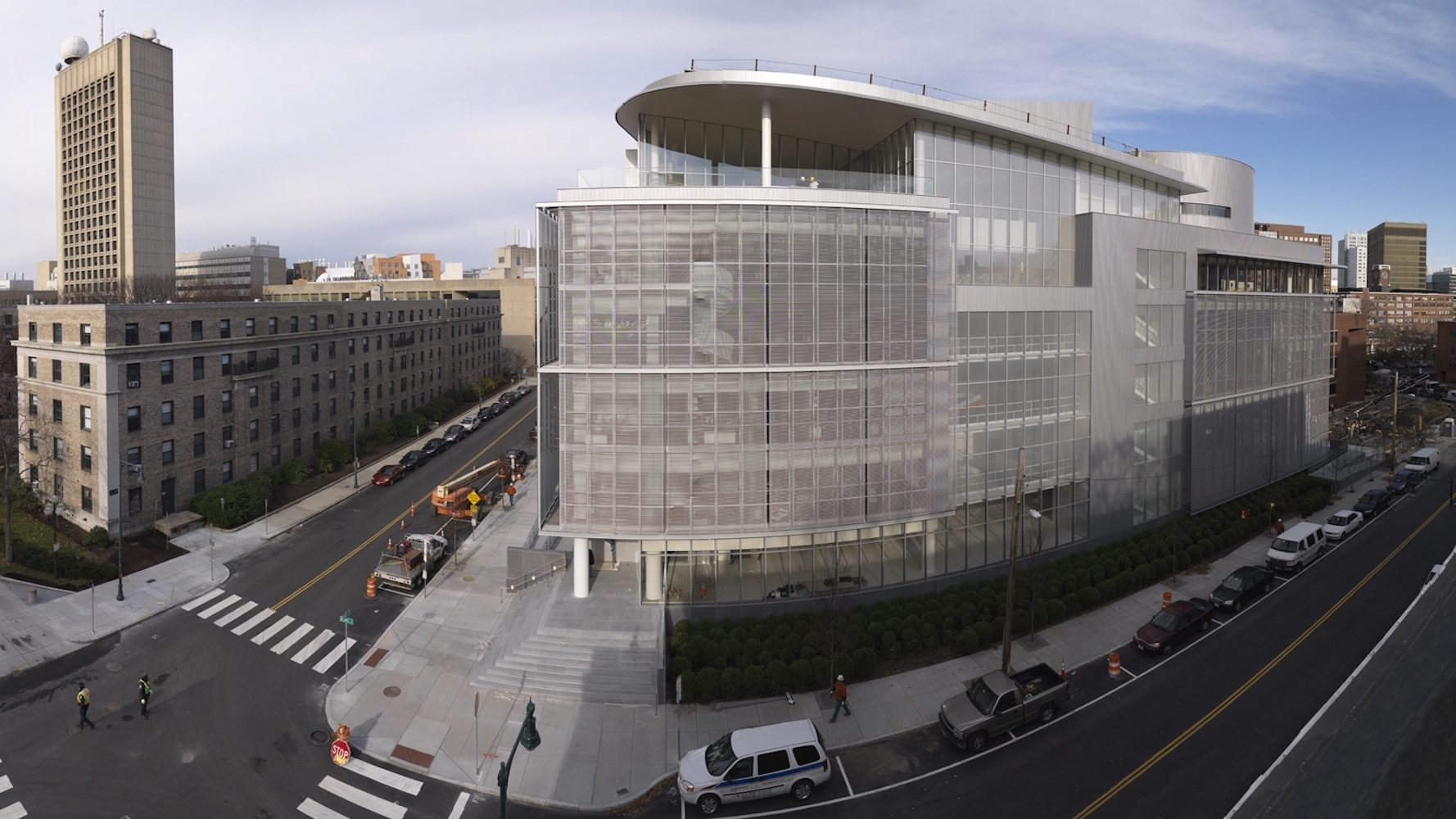
KTA's new projects, which is evident in the Melvin J. and Claire
Levine Hall at the University of Pennsylvania's School of Engineering
and Applied Science. The 48,000-square-foot facility houses offices,
laboratories, meeting spaces, and a 150-seat auditorium. Levine
Hall is shoehorned into a thicket of older brick and stone classroom
buildings and connected to existing buildings on the north and south.
The footprint and massing are calibrated to agree with the fenestration,
scale, and parapet height of the adjacent buildings. A newly landscaped
pedestrian walk leads to the double-height lobby on the eastern
facade, with a view through to a courtyard in the rear.
The construction method can be described as
a hybrid of sorts. The interiors were conceived as loft spaces with
14-foot ceilings. To achieve this, the architects designed a post-tensioned
concrete structure, which allows a substantial reduction in the
horizontal depth, thereby providing more usable volume within the
building. The building envelope, on the other hand, bears the fruit
of KTA's research into alternative construction processes.
Instead of the typical stick-built curtain wall, the architects
chose an active, ventilated unitized system. It's a double-facade
composed of large, unitized aluminum frames, which were fabricated
and glazed in a factory and shipped to the site for installation.
This system, while more common in Europe, has
not been employed much in the U.S. While more complicated to plan
(see sidebar, page 43), the final product has tighter tolerances
and a refinement that is striking. Furthermore, because of the efficiency
provided by the double facade, the glazing requires no tinting or
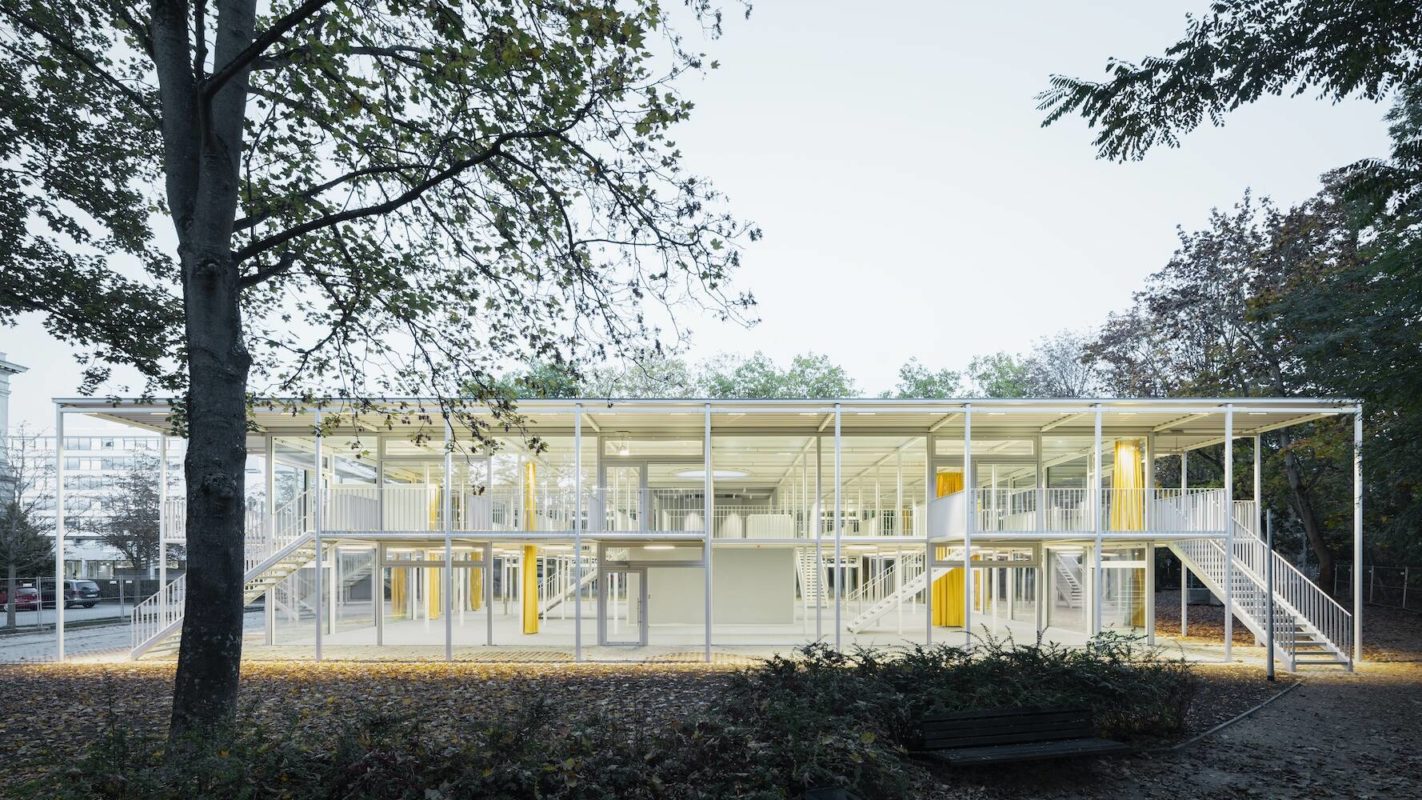
reflective coatings. Thus, the building is exquisitely transparent
in the day and sparkles when lit from within at night. KTA overcame
the cramped circumstances of the site and created for Levine Hall
a prominence that a sophisticated 21st century research center deserves.

Project: Melvin J. and Claire
Levine Hall, School of Engineering and Applied Science, University
of Pennsylvania
Architects:
KieranTimberlake AssociatesJames Timberlake, partner in charge;
Richard Maimon, AIA, associate in charge; Steven Johns, project
architect; Stephen Kieran, Albert Garcia, Yves Gauthier, Samuel
Robinson, Mark Sanderson, Chris Pfiffner, Richard Snyder, Amanda
Sachs, Krisada Surichamorn, Castor Kong, Karl Wallick, Meiko Sato,
Justin Doull, Kate Czembor, Matthew Spigelman, project team
Engineers:
CVM (structural); Vanderweil (MEP, fire); Barton & Martin (civil);
Arup (energy)
Fabricator (curtain
wall): Permasteelisa Cladding Technologies
Sources:
Auditorium seating: American Seating www.americanseating.com
Carpet: Karastan www.karastan.com
Ceramic tile: Dal-Tile www.daltile.com
Terrazzo: Roman Mosaic www.romanmosaic.co.uk
Brick: Glen-Gery www.glengerybrick.com
Read More:
New
Ways to Build Better, Faster, Cheaper
By Sara Hart
Architects Steve Kieran and James Timberlake use technology transfer
to rewrite the laws of conventional wisdom in design and construction.
|
|
|

Key elements for creating an
active, pressure-equalized, ventilated curtain wall
Hypothesis.
Create a dynamic image for a new engineering and applied science
facility. Emphasize the state of the art by allowing new technologies
to drive the design process
Process. Analyze
the wall, its components, and available manufacturers. Retain
an independent expert in energy and sustainable design issues
to evaluate the energy codes related to the program. Enlist
an engineer to develop calculations relative to comfort and
energy-code compliance.
Commission Permasteelisa Cladding Technologies in Italy to
build the components and ship to Philadelphia fully glazed
and ready for installation.
Value.
Due to the addition of the added layer of glazing, interior
blinds, and unitized construction, the curtain wall costs
more than a comparable "standard" wall. This premium
has been identified to be in the range of 25 to 35 percent
over a comparable wall of architectural grade. The increased
premium may be amortized over time by reduced energy costs.

|
|