| |
|

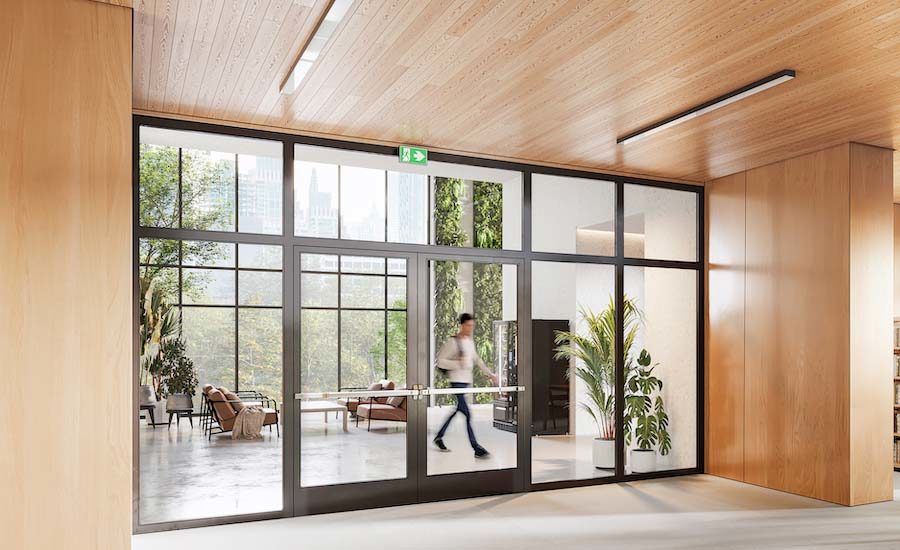
Icrave Design
Studio used Color
Kinetics’ LED cove lighting fixtures to illuminate this
Lucite catwalk at the Dorsia Lounge in New York City.


|
|
Some say it's just a matter of time before
light-emitting diodes (LEDs) eclipse traditional light sources,
although the sun isn't going to set on them tomorrow. Right now,
cost is the most obvious barrier to the acceptance of LEDs, except
in maintenance-intensive applications like traffic lights. The other
is their low efficiency, which today stands at a maximum of about
20 lumens per watt. "If output can go up by 10 times, and the
price can come down 10 times, then it will start penetrating into
lighting applications," says the Lighting Research Center's
Dr. Nadarajah Narendran, who envisions that these developments will
take five to 10 years.
Color rendering capabilities must also continue
to improve to make the technology practical for general illumination
purposes. "We don't feel the white LEDs are quite ready for
prime time," says Kevin Dowling of Color Kinetics, a Boston-based
manufacturer of LED products. "But two years from now, I believe
you'll be seeing massive improvements in efficiency and color."
But the advantages of LEDs are indisputable.
One is long life. "If an LED has 100,000 or 200,000 hours of
lifetime, it becomes equivalent to a building material," Narendran
continues. "All of a sudden the way we light our spaces is
different.
Another benefit of LEDs is that because they
operate on just a few volts and draw milliamps of current, they
produce no heat and can be directly controlled by a digital interface.
Lamps running on line voltage are usually controlled by rheostats,
mechanical relays, or large transistors. A number of Color Kinetics's
products take advantage of the ease with which LEDs can be digitally
controlled. The company has just introduced the Chromasic microchip,
which combines digital LED control and communications technology
into a single silicon chip. "This is a very big step in making
systems viable for large-scale implementation," says Dowling.
"It means you can control a single LED or a large panel of
LEDs."
The Chromasic chip is used to control Color
Kinetics' IColor Tile FX, pictured at right. Each tile is a 2-foot-by-2-foot
panel that contains 144 "nodes," each comprising a red,
green, and blue LED. Each node is about the size of a pencil eraser.
The brightness of each LED can be individually addressed so that
it is possible to create vibrant, moving displays of color. Up to
64 billion color combinations can be created.
In a similar vein, electronic controls could
be developed to adjust solid-state lighting to an unprecedented
degree to create different color temperatures. Bill Ryan, of Philips
Lighting, says, "In the morning, you could get 3,000 degrees
Kelvin, and in the afternoon, you could change that to 4,000 K."
Offices could adjust based not only on time of day and occupancy,
but on precisely where the occupants
are in the space.
New: LEDs in a
sheet
Organic light-emitting diodes are beginning to make their
way into prototype architectural applications, such as those supplied
by DuPont for KieranTimberlake's SmartWrap exhibit, and are also
being developed by Philips, General Electric, and other companies.
OLEDs comprise thin layers of organic electroluminescent material
sandwiched between layers of electrodes, all embedded in a base
material. Light is emitted when voltage is applied to the electrodes.
The assembly may be no thicker than a coin. Although the most sophisticated
OLEDs can display information exactly like the color liquid-crystal
displays found in laptop computers, they can also be quite simple,
displaying one color alone. They have many advantages over LEDs
that make them much more suitable for architectural applications:
They require no backlighting; they work in cold temperatures; they
are cheaper and easier to manufacture, and they're more energy efficient.
They are also more stable when applied over large areas. DuPont's
Olight Web site, www.olight.com,
promises that the day will come when OLEDs will be manufactured
in rolls. As with LEDs, cost and efficiency issues must still be
overcome. "Our ultimate goal is to get OLEDs more efficient
than fluorescents," says Anil Duggal of General Electric's
Global Research Center. She says that goal remains at least 10 years
down the line.
|