| |
|

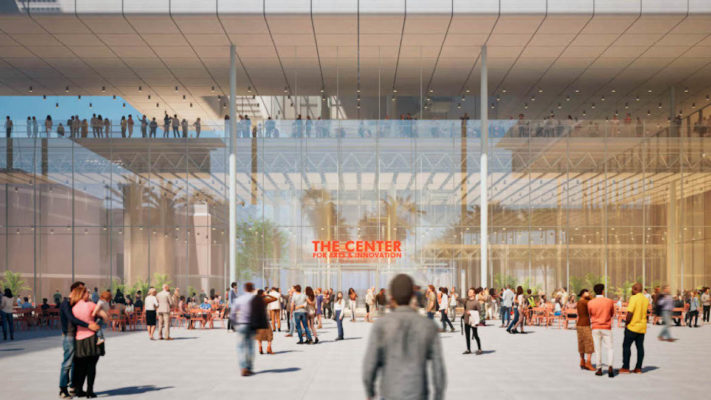
The California firm Morphosis
is experimenting with GenerativeComponents software
to design a new cultural building.

Images courtesy of
Bentley, developed by Morphosis
|
|
Some architects can program computers, some
programmers are architectsbut having the one skill shouldn't
mean having to have the other, says CAD pioneer Robert Aish, Bentley
Systems' director of research. New parametric design software
he has developed, GenerativeComponents (formerly CustomObjects)
is poised to allow even technophobes to harness computing power
for customized designs.
GenerativeComponents lets designers create
rules for a projectfor example, a complex stadium roof of
known dimensions and curvatureand form specialized components
to be used to construct it. These components then "populate"
a design that's generated automatically according to the rule. If
the rule changesif the designer modifies the roof's span or
curvatureso too do the shape, orientation, and behavior of
all its component parts, much like changing a formula in a spreadsheet
affects all the values on which that formula is based.
"This process enables architects to explore
design alternatives more quickly and capture geometric relationships,"
says Aish. This is not the case with traditional CAD, in which elements
such as walls and windows are merely graphical representations of
building parts. It also differs significantly from parametric programs
like Autodesk's Revit, whose chief benefit is production efficiency
achieved by embedding non-design information like cost and manufacturer
into well-understood building components like doors. Aish has been
vetting his tool for two years with a collective he helped found,
the SmartGeometry Group, whose tagline"Architectural
design with computational design tools"elegantly articulates
a fundamental challenge of the CAD era. Last summer the group convened
in Cambridge, England to put the tool through its paces and to educate
a larger audience of early adopters. Bentley plans to integrate
Generative Components into their signature CAD program, MicroStation,
in 2004.
Above all, Aish wants to introduce freedom
of expression in an era of digital fabrication and mass customization.
Users who want to create complex sculptural forms can still do custom
programming within the software, although, "if exploring modifications
to a design takes too long," he says, "you just exhaust
people."
|