









Yawkey Center for Outpatient Care
Cambridge Seven and Michael Fieldman bring order and an engaging public face to a large city hospital complex.
Originally published in the Building Types Study section of Architectural Record – June 2005
Adding a 440,000-square-foot clinic to an urban site already occupied by several buildings requires a talent for master planning, architecture, and logistics. Making the new facility work for patients and medical staff is no small feat, especially when the building has to attach to a historic structure and sit across the street from a busy transit station. All these constraints could have resulted in a seriously compromised design, but the team of architects working on the Yawkey Center for Outpatient Care at Massachusetts General Hospital (MGH) in Boston used them to emphasize the building’s role in establishing connections with its neighbors.
Based on what you have seen and read about this project, how would you grade it? Use the stars below to indicate your assessment, five stars being the highest rating.
Program
Like many big-city hospitals, MGH had grown piecemeal over the years. Although its core was strong—a handsome 1930s structure called the White Building, designed by Shepley Bulfinch Richardson—it had become an ad hoc collection of facilities, rather than an efficient or attractive health-care campus. It also needed a new ambulatory-care building to bring together various outpatient services scattered throughout the hospital complex.
Solution
In 2000, the hospital invited about 20 architectural firms to compete for the job of designing a master plan that would bring order and accommodate new growth. Cambridge Seven Associates and Cambridge Seven and Michael Fieldman teamed up and won the commission by proposing a master plan that aligns development along a central wedge defined by two axes, each angled about 10 degrees from the center of the White Building. The plan handles growth by tearing down some older buildings and garages at the medical center, and creating underground parking with new buildings above.
The architects positioned the first major component of the master plan, the Yawkey Center, to define the new west axis, aligned with Charles Street near the Charles River. This ambulatory-care center draws the hospital toward Cambridge Street to the south, engaging the campus with the Beacon Hill community and a renovated T station.
To the north, the Yawkey building literally engulfs the existing Northeast Proton Center, stripping away its exterior shell while retaining its high-tech core. The architects faced a different challenge to the west, where the Yawkey Center connects to the historic Charles Street Jail, an impressive stone structure that Cambridge Seven is now converting into a hotel. While the architects preserved most of the granite jail, they tore down part of its eastern wing, then rebuilt two of its bays as part of the new hospital building.
Future phases will extend the ambulatory center to a new building to the north (across Fruit Street) and then replace an existing garage on Fruit Street with more underground parking and a new meeting center.
Designed with an extensive glass-and-metal curtain wall toward the east, the Yawkey Center presents a Modern face to its neighbors and engages them with its transparent architecture. Aluminum brise-soleils on the upper floors protect the curtain wall from the full impact of the sun, while a generous glass-and-steel canopy covers the vehicular entry and almost touches the Fruit Street garage across the driveway.
On the ground floor, the architects emphasized the public realm, designing a spacious lobby and waiting area off the vehicular entry and a coffee shop and café off a curving plaza facing the T station. The plaza also serves as an outdoor room connecting the old jail and the new hospital building.
Inside the rebuilt bays of the jail, Cambridge Seven and Michael Fieldman worked with historic consultant Ann Beha Architects to preserve the old shell while creating a four-story-high space with a café on the first floor, a lounge on the second, and offices above. By pulling the floor plates away from the old facade and creating a multistory space with views out the tall windows, the architects echoed the jail’s sectional organization, explains Fieldman.
To bring daylight and views into medical areas, the architects organized clinics and waiting rooms along a single-loaded corridor just inside the building’s glazed curtain wall. Clear- and opaque-glass partitions separating clinics and medical offices (designed by Perkins + Will and Steffian Bradley Associates) from the corridor allow daylight to filter deep inside.
Commentary
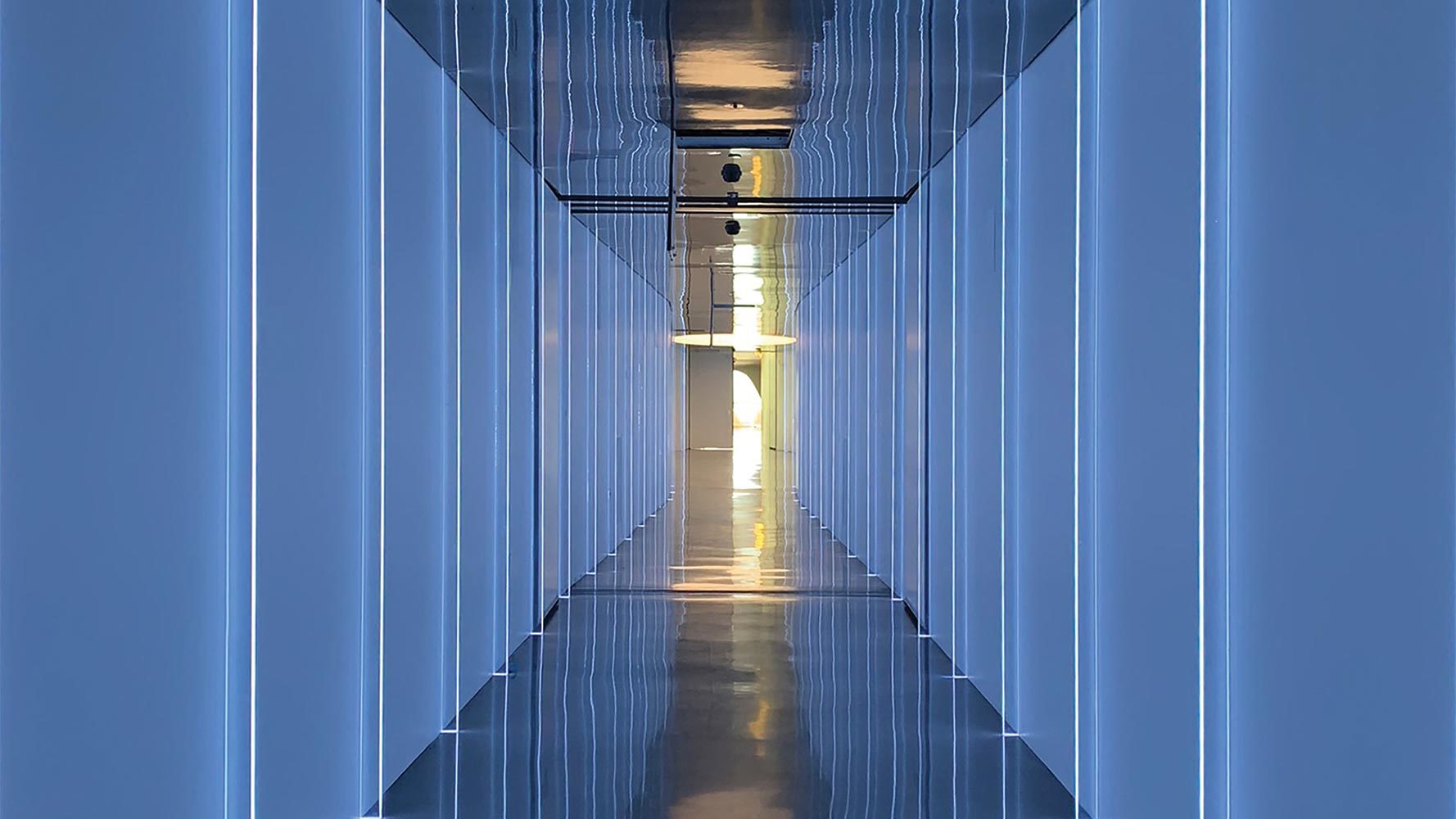
Corridors often give hospitals their dreary institutional feeling, but the sun-washed ones in the Yawkey Center create a lively setting for medical activities. The building’s simple plan and use of daylight also help visitors with wayfinding, while its transparent face provides an attractive gateway to the entire hospital campus.
Cambridge Seven Associates was tasked with reorganizing the plan of the whole Massachusetts General Hospital Campus while designing facilities for a new kind of operational structure at the Yawkey Center. A similar pair of tasks is increasingly assigned to many architects these days, so the extent to which the architect succeeded is very much worth considering.
“We began by thinking about the urban-scale opportunities this project permitted, including the beginnings of a clear entry and new identity for the campus,” says David Hanitchak, AIA, the hospital’s director of planning and construction. To that end, he is pleased with the way the project was able to clarify access and the location of ser-vices, and with the “significant improvements in traffic and parking.”
Hanitchak continues, “The project also set new environmental standards for ambulatory care, consolidates clinical programs scattered throughout the hospital, supports multi-disciplinary approaches to disease care, expands infrastructure, and permits future growth.”
Some design decisions were made in response to very specific elements of the program; others have more general application. “Almost all buildings we plan and design are singly loaded (with rooms on only one side of a corridor), schools and health care facilities in particular,” architect Michael Fieldman explains. “As users navigate these facilities, the views offer them some tangible connection to their neighborhood, to their environment, keeps them from feeling isolated. This is far more critical in an urban environment where the potential for alienation is stronger than in a non-urban environment. That is why circulation, light, and openness became armatures in plan development and subsequent design.”
In a hospital, Fieldman’s concern for creating “a tranquil tension and silent intensity, both through movement and material selection” is especially important. He is particularly pleased with the “feeling of permanence” at the Yawkey Center that was achieved with “craftsmanship that speaks to dignity, refinement, and the play of light and shadow.”
Hanitchak is also happy with the interiors. “Clinical interior space is quiet and calming and does not feel crowded: It is clearly zoned, with spectacular views reserved for the patients on the east side of the building,” he says. “Wayfinding is reinforced by colors, which along with the finishes and furnishings, were standardized into a series of coordinated colorways, simplifying selection while maintaining a different character for each service. The Healing Garden on the roof is a unique benefit for the Cancer Center’s patients and families, as the visitors comment book attests.”
The statements written in that book certainly attest to the garden’s success. “Words cannot describe how beautiful and serene this healing garden is. It is truly breathtaking. It really lightens up my day and spirits when I come here. I love it. Thank you!” one patient wrote. “I love to come here when I bring my wife for chemotherapy. This place always gives me strength and hope that all will be well,” the husband of another patient explained. Someone else noted the “beautiful views” and said the garden is “really delightful, a wonderful idea; it is calm, relaxing, and really appreciated.” Commenting on the garden’s “total serenity,” another patient said: “Body, mind, and spirit are at peace. A beautiful addition to this hospital.” Dozens more wrote similar things. Clearly the garden strikes just the right chord with people when they feel most vulnerable.
The only problem with the garden, says registered nurse Joanne Lafrancesca, is occasionally loud noise levels coming from it. Patients also complain about noise in the bays and resource rooms, but conversely they do like the spaciousness of the facility and the privacy this affords. “The natural lighting is something that affects patients and staff in very positive ways,” Lafrancesca explains. “The views are remarkable and therapeutic in and of themselves, especially in the bays with views of the river.”
On a specific planning level, Lafrancesca likes the layout of pods and private rooms but says the nurse call area has been a challenge: “We need more space in the nurses’ stations as we have grown.” A most serious failing, she adds, is that “temperature control in the patient rooms is atrocious and a daily challenge. And the electrically controlled faucets are terrible.”
Lafrancesca suggests that if the building were being designed today, she would perhaps “co-locate the physician practices with chemotherapy infusion, provide better space for urgent care, have a bed in every private room, and increase the bed-to-chair ratio. The pharmacy should be more central to the unit.”
Elizabeth Alterman, administrative director of the Cancer Center Clinical Programs, also talks about how the phenomenal growth of the Cancer Center over the past two years has affected the building. “Since occupying it, we have converted many of the offices from single to double offices in order to maximize space,” she says. “We have also removed the locker room to add more workstations and placed the lockers in the staff lounge as well as removed the Medical Records room on the seventh floor to create additional workspaces for staff.” If the building were being designed today, Alterman would “double up all non-MD and non-management offices, make all interior spaces exam rooms instead of offices, and not build Medical Records rooms.” She would also “engage all affected staff as early as possible and keep them involved in the process.”
What Alterman likes best about the building is “the footprint of the Cancer Center” on the seventh and ninth floors, which “work extremely well. We have no dead-end corridors, so we can move fluidly through the space as well as use exam rooms in a shared manner. If one program is out of exam space, the program adjacent to it can use the space.” She adds that patient flow is also a success. The building was designed to have “patients come in one entrance and exit through another. Centralizing the phlebotomy labs behind the front desk works very well. Specific zones for patients and staff, and private patient check-out stations have also worked well.”
For her part, the nurse manager for Ambulatory Gynecology, R.N. Linda Kelly, says “our department is thrilled with the Yawkey building. What we like best is the amount of space we have for our program. What works best is the design of our clinical pods. There are two consult rooms, three exam rooms, a bathroom, and a medical assistant workstation in every pod. The pod offers a quiet relaxed atmosphere for the medical team to work in.” Kelly adds, “We have made minimal alterations within our program—to accommodate a residency program and to improve patient flow within the clinical pod.” And if the building was being designed today, “We would probably change our patient check-in and check-out areas, moving them farther away from the waiting area” to make them more confidential.”
Staff satisfaction with the Yawkey Center is impressive considering that the building occupies a tight urban site. It’s doubly impressive since, as Hanitchak points out, “the building manages an enormous volume of visits, almost 700,000 per year, comparable to the passenger volumes of a medium-size U.S. airport such as those in Akron, Ohio, and Burlington, Vermont.” He adds that the facility, designed seven years ago, features a layout that exemplifies trends increasingly seen today: “larger floorplates, larger spans to increase flexibility, increased infrastructure to accommodate ambulatory and diagnostic procedures, universal layout, common IS systems, and standardized room sizes and types.” It bodes well for future development on the Massachusetts General Hospital campus.
- Natural light and views of the city beyond improve the morale of both patients and staff.
- A well-designed healing garden at an outpatient cancer center provides a refuge for patients and their families.
- Increase the bed-to-chair ratio in chemotherapy suites.
- Think hard and test the equipment before installing electrically controlled faucets.


Sign in to Comment
To write a comment about this story, please sign in. If this is your first time commenting on this site, you will be required to fill out a brief registration form. Your public username will be the beginning of the email address that you enter into the form (everything before the @ symbol). Other than that, none of the information that you enter will be publically displayed.