|
February 2006
By Ted Smalley Bowen
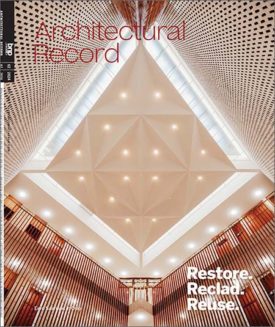
Frank Lloyd Wright's 1908 Unity Temple
in Oak Park, Illinois is considered an early Modernist masterpiece
for its compact monumentality and striking planar geometry.
Although its interior ranks among the great public spaces
of the 20th century, it proved uncomfortable almost from the
start. An advanced but poorly executed heating scheme meant
noisy radiators in colder months, and the lack of air conditioning
and proper ventilation made the building a sauna in the summer.
 |
Images: Courtesy Unity Temple
Restoration Foundation
|
 |
Last year the church's Unitarian Universalist
congregation and the Unity Temple Restoration Foundation began
the building's first major restoration, which is slated for
completion in 2009, the centennial of the building's dedication.
A significant component of the $12 million to $15 million
project addresses the building's HVAC problems through the
addition of a groundsource pump system for heating and cooling.
The project will also involve repairs to the temple's reinforced
concrete structure, refurbishing its interior woodwork, lighting
and art glass windows, a new electrical system, and modifications
for ADA compliance, including the installation of an elevator.
The project team, including Harboe Architects
of Chicago and Architectural Consulting Engineers (ACE) of
Oak Park, are working to balance the needs of the congregation
with strict preservation requirements for the landmarked building,
which comprises a temple, meeting hall, and entrance hall.
"The original users are still using it. It has to function
as a house of worship and as a tourist attraction," says
principal Gunny Harboe. "It also happens to be an icon
and one of most significant Wright sites in the world."
New HVAC efficiencies
In improving the building's indoor environment,
the congregation opted for a system that would reduce operating
costs and take less of a toll on the global environment.Ultimately,
the design team developed a system of geothermal wells. The
plan calls for a closed-loop fluid circulation system that
will carry an antifreeze formula of glycol, ethanol or another
environmentally benign substance. It also has provisions for
an ice storage system for producing ice overnight to reduce
the required chiller capacity, according to Mark Nussbaum,
principal of ACE.
Nussbaum is still working out the number
of wells and their exact depth , most likely 300 feet. But
he says adding the water loop and ice storage capability does
not add significantly to the cost of the project, given the
system's greater efficiency and reduced chiller capacity.
The new HVAC system will mostly fit within
the existing utility trenches and ducts at Unity, lessening
the impact on the original structure.
In a bit of function following historic
form, the scheme will be augmented by radiant heat, through
the reuse of some of the radiators installed the year after
Unity Temple opened.
Among Wright's innovations at Unity
was a forced air heating system, fed originally by a coal-fired
steam boiler. Poor performance led the congregation to add
steam radiators after the first winter, according to Nussbaum.
"The main duct could've heated the
whole building, but I don't think the distribution ducts were
big enough. It was also hard to balance and manage the airflow,"
he says.
The boiler was converted to oil in the
early 20th century and to natural gas by the 1970s, according
to Nussbaum. A high efficiency natural gas boiler will replace
the latter to provide backup heat and heat for cooking, he
said.
The new scheme's demand/control ventilation
system, which is triggered by carbon dioxide levels (which
indicate the number of occupants), is tailored to the needs
of both users and the historic building fabric, according
to Nussbaum.
"It brings in only enough fresh
air to meet actual needs, and it allows for a porous building,"
he says.
Unity's single-glazed leaded art glass
is leaky and difficult to control thermally. But measures
like storm glazing would compromise the building's aesthetics
and could create moisture problems, according to the designers.
Nussbaum says Unity's HVAC needs don't require an airtight
building. "We don't have any delicate museum artifacts
here," he says, "so we can improve indoor comfort
without damaging the building's shell, which is pretty hearty."
ACE created software models of the building's
energy performance, although its as-built conditions have
never been fully documented. "It's difficult to do energy
modeling for a building when we don't thoroughly know its
construction," he says. "There are some voids in
the masonry walls, for instance, but it's not clear exactly
where they are."
But the models were accurate enough to
approximate the building's performance with its present equipment
and consumption levels. Overall, the calculations predict
better efficiency during the heating season, which should
compensate for the new cooling load. "We expect to see
a 40 to 50 percent reduction of utility bills over what a
conventional HVAC system costs," he says. Geothermal
systems typically put out 80 percent less source emissions
compared to systems powered by fossil fuels, he says.
Making the old new again
Wright's cast-in-place concrete structure was innovative
for its time, and is still sound, despite some cracks and
spalling, according to Harboe. "We're not anticipating
replacing rebar," he says. "The major work was the
overhangs," he says. Unity's signature heavy eaves were
rebuilt several years ago.
The temple skylight requires significant restoration. "It's
our intent to go back to the original design. There is some
of the original fabric, but there's a question of how much
we can reuse," says Harboe.
| |

A photo dated 1925 shows a
womens group that may have been part of Unitys
early congregation. |
Most of the temple sanctuary's oak trim is original and much
of its original clear resin finish remains, according to Harboe.
Wright applied color washes directly to the interior's plaster
walls. These were subsequently covered under many coats of
paint. The restoration team is looking to replicate the original
washes.
Maintenance also figures in the restoration, as the designers
consulted records of Unity's previous upkeep for clues to
how building has changed over the years. They will also provide
guidance on maintaining the newly refurbished building, according
to Harboe.
One concern for the interior is that the planned changes,
such as the new mechanical systems, air handlers and the like,
might affect the temple's excellent acoustics.
The work is being reviewed by a team of architects, engineers,
and preservation specialists, whose task is to anticipate
the effects of any physical and aesthetic intrusions, and
to verify that the new work is reversible where necessary.
"We want to make sure we do no harm," Harboe says.
"I think it's doable without any major gymnastics."
|