|
By Nancy B. Solomon, AIA
Rinker Hall
As architectural commissions go, Rinker
Hall in Gainesville, Florida, represents both the extraordinary
and the ordinary: extraordinary because the building is the
new home of the M.E. Rinker, Sr., School of Building Construction,
a department of the University of Floridas College of
Design and Construction, so the client and stakeholders were
themselves well-versed in the art and science of place making;
ordinary because, as is typical of a project for a public
university, its funding was limited. The client and architectural
team demonstrated that, by working closely and thoughtfully
together from the start, an attractive, high-performance design
could be delivered within a standard schedule and a no-frills
budget. Completed in March 2003 for a mere $137.50 per square
foot, Rinker Hall received a LEED rating of gold in 2004.
It was an exercise in resourceful
design, says Randolph R. Croxton, FAIA, of Croxton Collaborative
Architects in New York, which undertook the project through
a joint venture with Gould Evans Associates, a firm with offices
in seven locations, including Kansas City, Missouri. Its
almost a bare-bones, reductionist building, suggests
Croxton, yet it has an inherent richness that wont
diminish over time, because its panache comes from nature
rather than from very expensive, capital-intensive gestures.
|
|
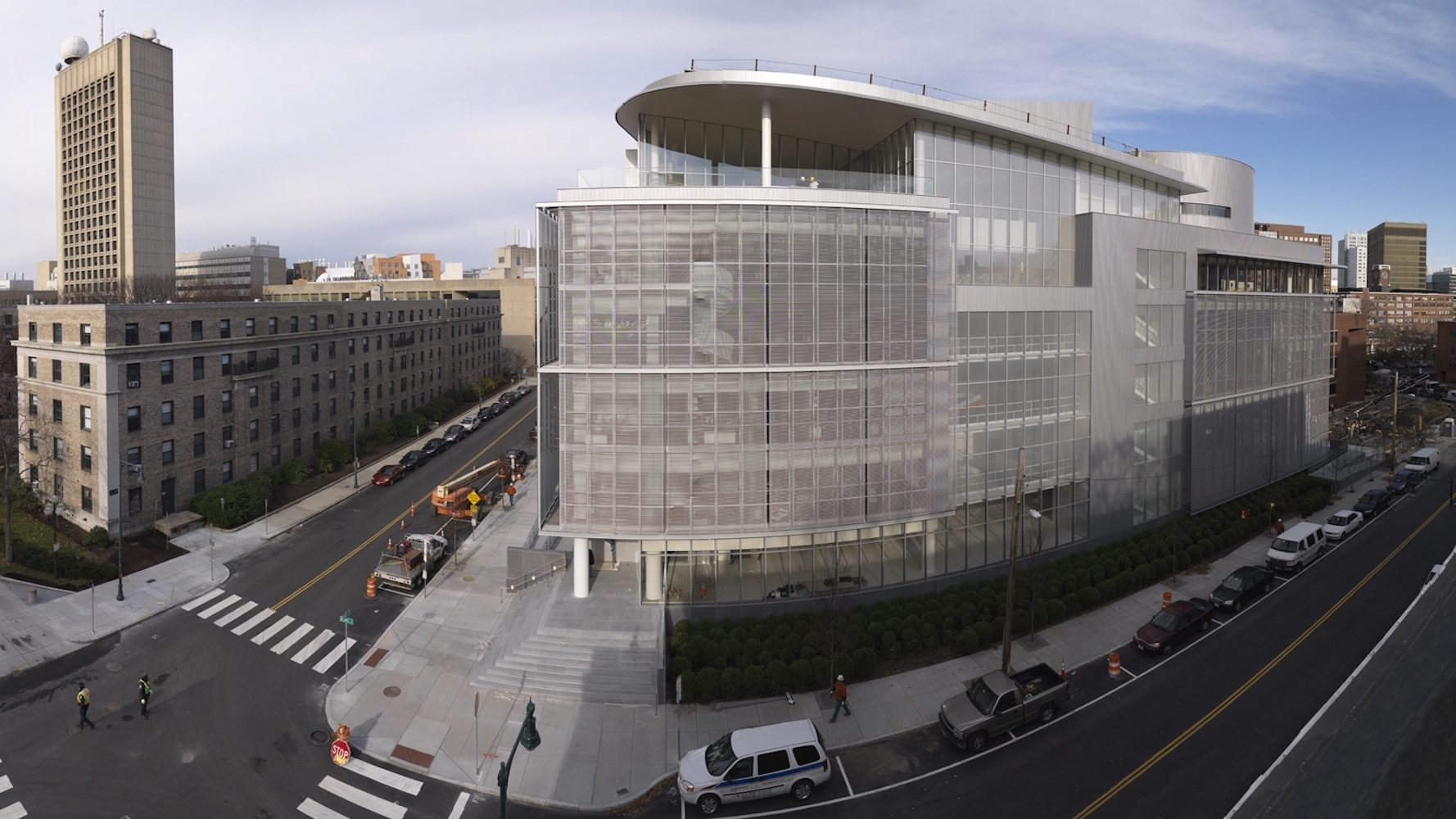
Rinker
Hall, Gainesville, Florida
Croxton Collaborative Architects + Gould Evans
Associates oriented the University of Floridas
School of Building Construction on a north-south
axis to capture low-angle light (far below).
A brick-walled outdoor area (top) serves as
a construction yard. An enthalpy wheel filled
with dessicant crystals rotates between intake
and exhaust-air flows to transfer heat and
moisture from the incoming stream to the outgoing
one, reducing the buildings operational
costs (below). |
|
|

Photography: © Timothy Hursley |
|
|
Reflecting the belief that sustainable
design embodies not only environmental concerns, but social
and economic ones as well, the design team chose to orient
the building along a north-south axis out of respect for existing
landmarks, and to use patterns identified during a three-day
site-planning charrette with students, faculty, and staff.
It was determined, for example, that the main entrance to
Rinker Hall should front Newell Drive, which runs along the
west boundary of the site, because the road leads north to
the heart of the campus. In addition, participants wanted
to preserve an open commons area to the northeast, a footpath
along the southern edge, views north to the universitys
memorial tower from two dormitories south of the site, and
several hundred-year-old specimen oaks.
A north-south axis in this part of the
hemisphere flies in the face of conventional, passive-solar
design, which teaches that a rectangular building should run
along an east-west axis so that its long elevations will face
north and south. At the latitude of Gainesville, this configuration
minimizes thermal exposure to the hot summer sun but also
limits daylighting opportunities.
|