|
By Nancy B. Solomon, AIA
This article is also available
for Continuing Education credit here.
We demand a great deal from the building
envelopethe skin that shelters us from the outside world.
For starters, it must protect us from rain and snow, provide
appropriate amounts of sunlight and fresh air, retain interior
warmth in the winter and resist exterior heat in the summer,
all the while exuding an aesthetic that suits owner and public
alike. To this intricate mix, add the tantalizing promises
of new materials, products, and systems, and ever more stringent
energy, security, and other requirements, and the job of designing
a buildings outer shell becomes very complicated indeed.
So complicated, in fact, that some fear architects may be
losing their grip on this most visible building component.
The exterior of the building is how architects identify
ourselvesits our calling card, yet we are no longer
in control of it if we dont know the building science
and the technology necessary to design high-performing envelopes,
says Richard Keleher, AIA, a technical-quality and drawing-review
consultant in Concord, Massachusetts, and former director
of building-envelope technology at The Stubbins Associates.
He predicts that, if things continue as they have in recent
years, envelope consultants may one day be dictating the look
of our buildings.
Fortunately, three recent national efforts
to improve the performance of building envelopes are laudable
steps toward remedying the current situation. These include
the publication of the Building Envelope Design Guide, a comprehensive
resource for the design and construction of institutional
and office buildings; the Exterior Enclosure Technical Requirements
for the Commissioning Process, which outlines a step-by-step
process to ensure that a new envelope will function as intended;
and the formation of building enclosure councils, which establish
a forum within which practicing architects throughout the
country can begin to learn the fundamentals of building science
and discover regionally appropriate solutions.

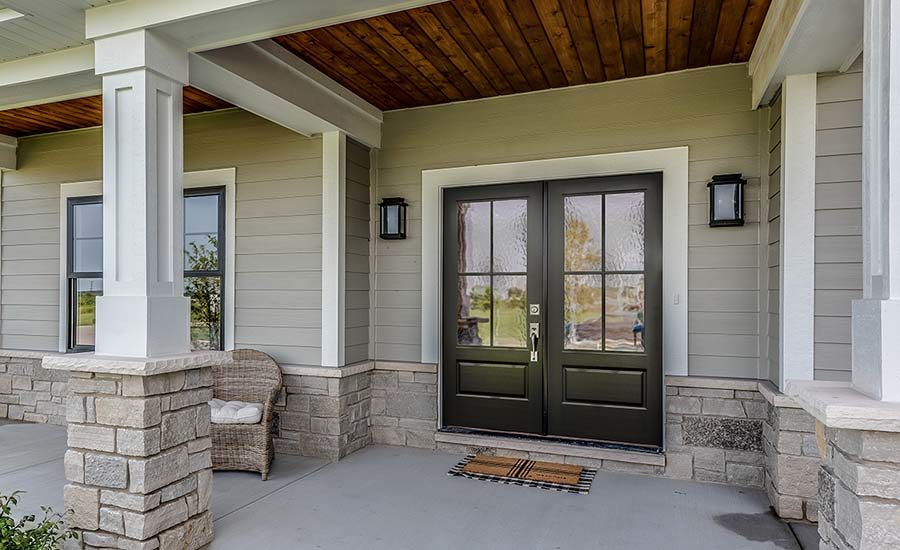
A battery of tests
was conducted on a mock-up for the exterior
lab wall of the Childrens Hospital of
Milwaukee, designed by Shepley Bulfinch Richardson
and Abbott.
Photography: Courtesy Shepley Bulfinch Richardson
and Abbott |
|
|
Although all three efforts evolved separately,
the complementary programs have coalesced under the auspices
of the National Institute of Building Sciences (NIBS), in
Washington, D.C., a nonprofit, nongovernmental organization
established by the U.S. Congress in 1974 to serve as a bridge
between government and the private sector in order to improve
the quality and efficiency of construction in this country.
Among many other functions, NIBS disseminates technical information
and helps introduce appropriate technologies into the building
process. Referring to the advancement of high-performance
envelopes, NIBS vice president Earle W. Kennett observes,
No one discipline figures this into their domain because
of the multidisciplinary nature of the work. Nonetheless,
to achieve high-quality enclosures, it is critical that the
different disciplines interact and learn from each other.
As an experienced intermediary among the varied facets of
the design and construction industry, NIBS was well positioned
to take on these new, inherently multidisciplinary initiatives.
|