|
By Nancy B. Solomon, AIA
This article is also available
for Continuing Education credit here.
For architects who grew up in the United
States, there are certain woods that seem as Americanand
as familiaras apple pie: oak, pine, and maple, to name
just a few. Early on, some foreign woods became well known
in certain domestic applicationsexamples include teak
for outdoor furniture and mahogany for fine cabinetrybut
they were indeed the exception to the rule. Times have changed,
however, and American architects are being enchanted by a
broad palette of exotic speciesfrom afrormosia to wengewhose
names, let alone attributes, many are still trying to learn.
What makes a wood exotic? According to
Dan Meyerson, who has been selling wood veneer to architects
from the New York office of Bacon Veneer Company since 1993,
there is no official definition. Generally speaking,
the layperson thinks that it is a wood from a tropical rain
forest, he explains. For some, however, exotic connotes
wood from trees that are rare or endangered, no matter where
they take root. For those in the building trade, the term
can refer to the kinds of woods that are highly desirablebecause
they are extremely well suited, in terms of both aesthetics
and workability, to structure, finishes, or cabinetrybut
whose availability is limited. Even if a particular species
can be found in abundance, an architect or woodworker may
not often find a high-quality specimen within that species
that can meet desired design and construction standards.

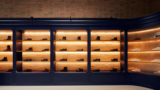
Gary Lee Partners
specified pearl movingue veneer for Madison
Dearborn Partners Chicago lobby. The
temperate wood from Africa was dyed in Italy.
Photography: © Steve Hall/Hedrich Blessing
|
|
|
In keeping with Websters primary
definition of exoticforeign; not nativeany
wood that is not indigenous to our country would fall into
this category. Many types of woods are imported into the United
States from both temperate and tropical countries, and they
are used in any number of applications, from structural lumber
to panel veneer. Interest in these woods is clearly growing:
According to Foreign Trade Statistics, which is provided by
the Department of Commerces U.S. Census Bureau (www.fas.usda.gov/ustrade/ustimbico.asp),
43 percent more tropical hardwood lumber and a staggering
358 percent more hardwood flooring entered this country from
abroad in 2003 as compared to 1993.
|