|
Companies can build a power
plant for free right in your backyard
if the price
is right
By Lindsay Audin and Deborah Snoonian, P.E.
 |

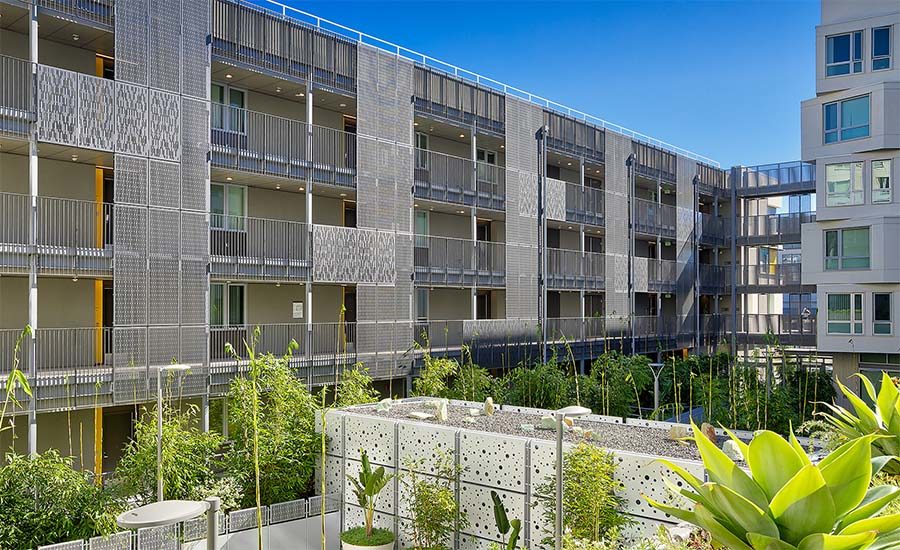
On-site power plants with natural-gas-powered
turbines (above) give juice to single buildings or multibuilding
facilities, such as apartment complexes.
Photography: Courtesy Capstone Turbine Corporation
|

Photography: Courtesy Punchstock |
Rolling blackouts in California.
The Northeast Blackout of 2003. Incentives
and tax rebates for sustainable-energy initiatives.
These wake-up calls have cast attention
not just on renewable-energy sources, but also alternative
delivery strategies, such as distributed power generation
(DG), where small-scale power plants, typically powered by
natural gas, are located at or near the buildings they serve.
Though attractive in the abstract, the high cost of constructing
DG plants, and the challenges of operating and maintaining
them, have sent potential customers running for cover.
A new business model for energy delivery
might reverse the trend, however. Several providers now offer
to build and operate DG plants at no cost when facility owners
sign a long-term service contract. Companies offering whats
been termed DG-for-free include RealEnergy (www.realenergy.com),
DG Energy Solutions (www.dg-energy.com),
OfficePower (www.officepowerllc.com),
and Hess Microgen (www.hessmicrogen.com).
Not surprisingly, the coastal areas of the U.S., where energy
costs are highest, have driven the market for this service.
Typically, a DG-for-free firm will offer
an owner a contract to supply power and heat to a facility
(either a single building or group of buildings) at a guaranteed
6 to 9 percent discount off current and future energy prices.
In exchange for a 10- to 20-year supply contract, the DG firm
handles design, permits, construction, operation, and maintenance
for the plant. To determine the feasibility of installing
DG-for-free, companies usually offer to analyze a buildings
power needs and systems (whether new or existing) at no charge.
Its a bit like getting a free mobile phone when signing
up for a two-year calling plan, which itself evolved from
Gillettes pioneering profit strategy: Give away the
razor, make money on the blades.
Typically, DG-for-free is not offered
as stand-alone, off-the-grid power. For the most part, these
services can supply from 40 to 75 percent of a buildings
energy needs, with the remainder and peak loads still covered
by a local utility, or the facilitys own boilers or
steam services.
For owners, the economic benefits of
DG-for-free seem too good to turn down at first blush. Those
who occupy their own buildings can bolster their bottom lines
by saving energy, or invest these savings elsewhere. Owners
of commercial buildings could pocket extra profit while passing
along typical utility rates to tenants. In the wake of the
blackouts and 9/11, decentralized power gained sway as a safer,
more sustainable option for power generation in the long term
than linking to an already overburdened, vulnerable grid.
Despite its inherent benefits, several
technical and logistical challenges remain hurdles to its
widespread adoption, say energy experts. What provisions for
backup power exist, for instance, if a DG plant goes down?
Does the plant create new, hidden operating costs, like greater
water consumption, or does it trigger the need for additional
emissions permits? Does the plants installation require
new, and perhaps costly, fire-code upgrades? Will a DG plant
raise insurance rates if fuel is stored on-site? Will power
quality be as reliable as with utilities, and how would providers
handle potential damages caused by power spikessay,
if a tenant company loses critical computer data during such
an event?
Also, because DG-for-free companies arent
regulated like public utilities, customers of their services
may relinquish many of the legal supports and protections
theyre normally entitled to when using traditional utility
companies. Owners need to weigh those risks carefully when
considering DG-for-free, especially if unforeseen events like
an extended loss of service or damage caused by a surge, fire,
or other accident could bring their operations to their knees.
Service providers are working to address
these challenges, though, and the life-cycle savings DG-for-free
offers makes it worth a look for new construction or buildings
undergoing system upgrades.
In time, these nimble companies will
be able to beat the utilities at their own game.
|