![]() |
Min | Day |
A firm finds fertile ground for innovation in the Midwest, as well as on the left coast
Since starting their firm in 2003, Jeffrey Day and E.B. Min have operated in two worlds — the hilly streets of San Francisco and the flat plains of Nebraska. The origins of Min | Day date back to the early 1990s at the University of California, Berkeley, where both partners went to graduate school and shared a love of conceptual art. While working in the Bay Area, the two considered starting their own firm, but the timing didn’t seem quite right. Only when Day decided to move to Nebraska with his fiancée and take a teaching position at the University of Nebraska did their talks get more serious. “Most people thought we were crazy to start a firm right when Jeff was leaving for Nebraska,” says Min, who stayed in the Bay Area. “But we thought that unexpected opportunities might arise out there.”
Based on what you have seen and read about this project, how would you grade it? Use the stars below to indicate your assessment, five stars being the highest rating.
Over the past six years, their unorthodox move has proved to be one of the firm’s largest assets. “A lot of people think that architecture only happens on the coasts,” says Day, “but we actually do some of our most experimental work in the Midwest.” A good example is a master plan and renovated barn shed they designed for Art Farm, an artist community in Marquette, Nebraska. “There is a lot of romanticism attached to the image of the barn, but we weren’t into that,” remarks Day. “Farmers repurpose barns all the time, so we had no hesitation cutting into the structure and inserting something entirely new.” The architects resurrected the 100-year-old weathered building by inserting a curving, digitally fabricated foam interior where visitors can recline and watch video installations by Art Farm residents.
For Art Farm and other clients with marginal profits, Min | Day often works with its allied practice FACT (Fabrication And Construction Team), a group affiliated with the University of Nebraska’s architecture school and staffed by students, research assistants, and paid interns.
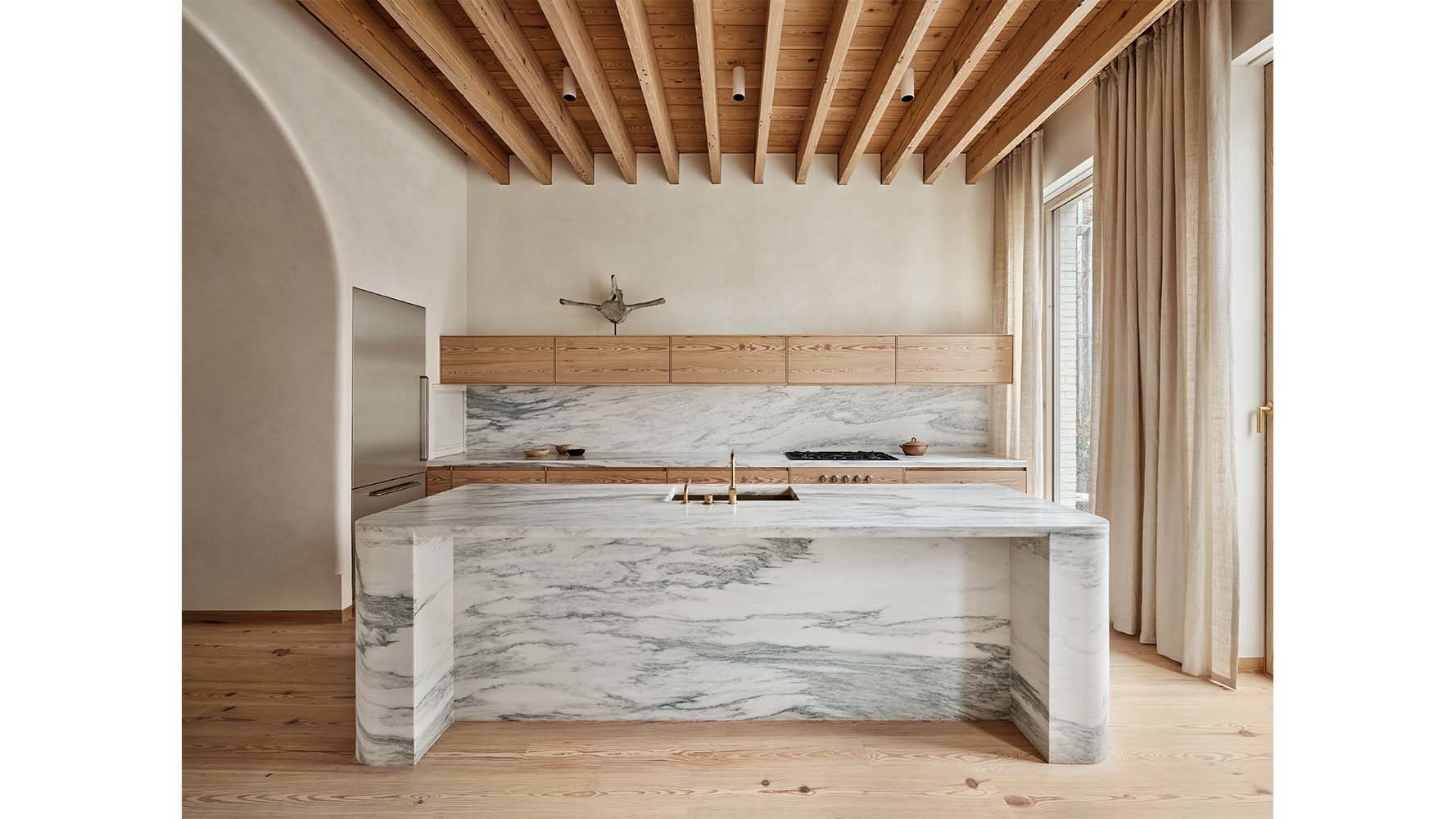
While Min and Day work with a wide variety of clients and at a range of scales, their projects consistently reveal their detail-driven process and technological savvy. For a vacation house on Lake Okoboji in Iowa, a rippling CNC-milled headboard in the master bedroom mimics the nearby lake surface, and the kitchen is filled with custom-designed furnishings. In an Omaha condominium, light filters through digitally fabricated screens designed to look like prairie grass — a nod to the natural world beyond the project’s walls.
Throughout the two architects’ careers, nature and landscape has seeped into their work. “When I visit Omaha, I love seeing how the landscape changes from rolling hills to foothills to flat farmland,” says Min. “It just keeps your eyes fresh.” Min’s infatuation with nature started when she worked at San Francisco—based Andrea Cochran Landscape Architecture. “In landscape architecture, you deal with color all the time,” continues Min. “Seeing how it was used in landscape opened my eyes to using it in architecture.”
Vivid shades emanate from much of their work. Color serves as an accent in one project, envelops an entire room in the next, and is completely absent in another. But color is not the defining theme of their practice. “We’re not trying to apply a theoretical idea about color when we go into a project,” says Day. “Our work always stems from the conditions we’re dealing with, not a preconceived framework.”
Given the current state of the economy, the firm continues to experiment, but on smaller scales. Recently, it has dabbled in furniture design and created floor plans for Hometta.com, a Web site that sells house plans online. Even though work is slowing down, Min and Day remain hopeful about the future of their firm. “I could see our work looking very different in the next 10 years because we don’t have a stylistic agenda,” says Day. “We’re all about improvising with the conditions at hand and creatively tackling any problems that arise.”
Min | Day
LOCATION: San Francisco, California, and Omaha, Nebraska
FOUNDED: 2003
DESIGN STAFF: 5
PRINCIPALS: E.B. Min, Jeffrey L. Day
EDUCATION: Min: University of California, Berkeley, M.Arch., 1993; Brown University, B.A., 1989; Day: University of California, Berkeley, M.Arch., 1995; Harvard, B.A., 1988
WORK HISTORY: Min: Min Studio, 1998—2002; Delaney and Cochran, 1995—99; the Bay Architects, 1993; William Savidge Architecture, 1989—90; Nicholas Allston Architects, 1987—88; Day: Fernau & Hartman, 1996—2000; Lahn Architects, 1995; Burks-Toma Architects, 1989—92; William R. Sepe, 1984 and 1988; CBT, 1987
COMPLETED PROJECTS: Lakamp Residence, San Francisco, 2009; Spirits Pavilion, San Francisco, 2008;
Soft Cube at Bemis Center, Omaha, 2008; Art Farm Red Shed Video Lounge, Marquette, Nebraska, 2008;
L Residence, Omaha, 2008; House on Lake Okoboji, Iowa, 2007
CURRENT PROJECTS: Bemis Center, 2010—; Art Farm, 2010—; Antelope Valley Reflecting Wall, 2011; Platte River House, Nebraska, 2011; Meadow House, Nebraska, 2011
WEB SITE: www.minday.com
|
|
Get Architectural Record digital with free bonus content not found in the magazine!
Order back issues—complete your library!


Sign in to Comment
To write a comment about this story, please sign in. If this is your first time commenting on this site, you will be required to fill out a brief registration form. Your public username will be the beginning of the email address that you enter into the form (everything before the @ symbol). Other than that, none of the information that you enter will be publically displayed.