Technological advances have transformed mathematics from a loyal handmaiden to architects to a muse, largely because of the advent of accelerated desktop computing and advanced design software. Sophisticated software frees today’s architects from endless calculations, making complex forms like Mobius strips and water bubbles almost as easily achievable as conventional rectilinear forms—a phenomenon that was unimaginable a decade ago. This book—about the increased role of mathematics as a driving force in design—by husband and wife Jane and Mark Burry, is thoughtful, engaging, and richly-illustrated. Most of their more than 40 projects have been built, while a daunting few, perhaps fortunately, remain unrealized except as labyrinthine models or exotic algorithms.
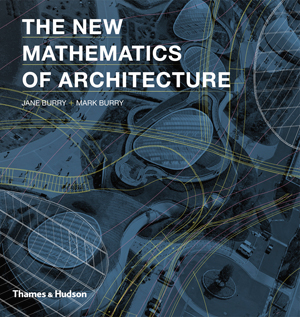
The authors display and analyze their projects through six topical areas: mathematical surfaces and seriality, complexity theory, tessellation, optimization, topology, and datascapes. The Burrys simplify exceedingly abstruse mathematical and geometric theories so that even the most non-mathematically-minded architect can follow. But the book’s organization—by mathematical theory rather than by project type—makes searching for practical applications unwieldy.
Despite the title broadcasting “New Math,” several showcased projects - Foster + Partners’ Battersea Power Station hexagonal auditorium for example -reinforce the potency of designing with the ancient Golden Mean in mind. Heneghan Peng’s majestic Grand Egyptian Museum, whose translucent stone wall is ornamented by a veritable shower of triangles within triangles, uses a fractal theory nearly a century old. A monumental wall, described by the Burrys as the museum’s “main tectonic and iconic event.” wraps around the building, even extending beyond it. All the galleries have sightlines through generous windows to Cairo’s ancient pyramids a short distance away. No more moving example of how the newest technology can return us to the wonder of ancient design is imagainable.



Post a comment to this article
Report Abusive Comment