Forty thousand people die every year in auto accidents in the United States — 400,000 every decade. Far, far more than have died from terrorism in this country. But we do not respond by withdrawing the right to drive.
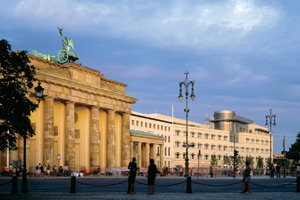
It’s an analogy that occurs to me whenever I see the latest field of bollards or other barriers in front of a government building, or enter a corporate lobby that’s been privatized by security guards. Because of the threat of terrorism, we are slowly withdrawing the right of free civic movement and assembly.
Safety is important, of course. But how does a society locate the balance point between security and freedom? And who makes that determination for the rest of us?
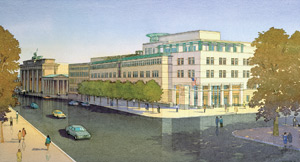
These are thoughts I’ve harbored since a recent visit to the new American Embassy in Berlin, which opened in July on a site near the Brandenburg Gate. In what now seems like decades ago, I served as a juror in the design competition for this embassy. That was back in 1995. A brilliant proposal by Santa Monica architects Moore Ruble Yudell (MRY) beat out designs by five other distinguished architects.
That competition jury reached its verdict in a surprising manner. We jurors were a diverse group of seven: a former mayor of West Berlin, a former U.S. ambassador, three architects who mostly practiced, one who mostly taught, and one (me) who mostly wrote. After the State Department filled us in on the program in great detail, each of the competitors came and presented its design in person. We were asked by the professional adviser, Don Stastny, not to discuss the entries among ourselves; he didn’t want cliques forming. Finally, we took what was supposed to be merely an informal straw ballot to get a sense of which designs had a chance at winning. Each of us could vote for as many as we wished. But not a single juror voted for any of the five other entries. All seven voted only for the one by MRY. Seven diverse observers had arrived, independently and without discussion, at the same conclusion. It was a result unique in my experience.
After such a prologue, I was, needless to say, looking forward to seeing this remarkable design as actually built. I was in Berlin in September for a one-day symposium, held in the embassy itself, where a group of a dozen or so invited guests gathered to discuss the subject of embassies and embassy architecture. We were led by John Ruble of MRY and writer Diana Ketcham. We toured the embassy with Ruble, and also the nearby British Embassy with its architect, Michael Wilford.
I came to several conclusions, all of them depressing.
The American government and its security experts turned a potentially great building into a merely acceptable one. (I don’t go so far as a writer for one German newspaper, who called it “an average state government building from New Jersey.”) I admire MRY for hanging on to as much of the quality as they did. But to most people, including me, the embassy looks like a lonely fortress, withdrawn from the city behind wide swaths of what I can only call no-man’s-land, which isolate it like a noxious germ on a microscope slide. Sometimes the strip of no-man’s-land is filled with a hideous forest of black bollards; at other times, it’s hidden behind a fence of fierce, tall steel palings.


Post a comment to this article
Report Abusive Comment