|
|
Return
to work |
When Los Angeles-based architect Chantal Aquin was asked to design a new service center for the Skid Row Housing Trust, she was faced not only with a low budget, consisting entirely of a HUD grant, but limited practical experience as well. Not willing to sacrifice design, Aquin turned these limitations into assets, mixing resourcefulness with ingenuityand a lot of plain old hard work. Jim Bonar, director of the Skid Row Housing Trust,
an organization that provides permanent housing and supportive services
for residents of Los Angeless Skid Row neighborhood, wanted something
different for its new Service Spot. Located on the ground floor of one
of the organizations single-resident-occupant hotels, Service Spot
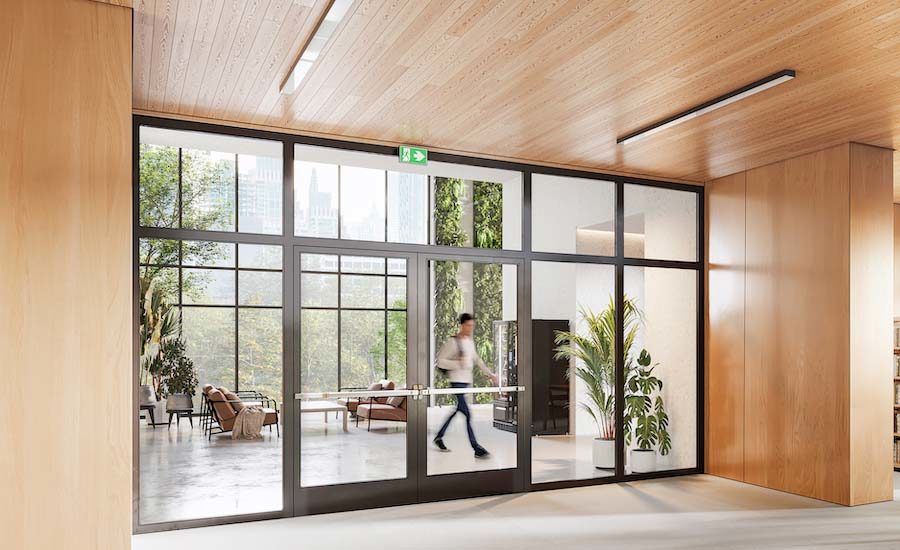
was to be a user-friendly center When it comes to designing for the homeless or mentally ill, theres typically a very distinct separation between public and private spaces, explains Aquin. There is a sense of fear there, since its sometimes difficult to anticipate their behaviorso many of these centers are designed with barriers. Instead, Jim wanted users to feel a sense of ownership of these spaces. We also wanted the residents to feel as though they were given something precious, not just services contained within blank walls. To stretch her limited budget as far as it could go, Aquin, just a couple of years out of SCI-Arc, enlisted help from current students as well as fellow alum Rocio Romero and former SCI-Arc instructor Randall Wilson. Wilson led an intensive summer studio in which students designed and built the seating, workstations, filing trolleys, and cabinets for the refurbished storefront. Though Bonar was skeptical of their ability to furnish the space, students received material donations from Home Depot, Anderson Plywood, and Häfele and were able to outfit the entire 2,000-square-foot space. The reception area is designed as a light box visible from the street to welcome visitors. Inside, the standard syntax of public-to-private space confronted by users of most public service agencies is twisted to create an interweaving of private with public spacesallowing users to walk freely from one activity to another with no physical obstacles. Transparent and translucent materials allow users to see the activities in which they will ultimately participate with no fears of being engulfed by authorities or institutions. Service Spot is included in the current exhibition “Communities Under Construction” at the Architecture and Design Museum, Los Angeles, which features projects low on financing but high on inventiveness as they attempt to use design as a powerful tool to achieve change. The exhibit runs through July 1, 2004. For more information on this exhibit: www.cityworkslosangeles.org |
|
|||||
|
|||||||