home
subscribe
free e-newsletter free e-newsletter
reader service
widget
advertise
Subscribe to Architectural Record today
and save 60% off the newsstand price.
comment

Dwayne Oyler and Jenny Wu  
The Galante Architecture Studio

By Ingrid Spencer

When you come from a family of builders, what choice is there but to be an architect? For Theodore Galante, AIA, his family members’ capacity to make things both inspired and contributed to what he calls a “mystic assumption” that he’d follow that route. “My father had a steel-fabrication shop on Long Island, and he hand-built the house I grew up in,” he says. “It seems like I was always in the middle of a construction site.” Still, Galante strayed off the path for a while after college with a stint on Wall Street. “I found out pretty quickly that I’m not cut from that kind of cloth,” he says. He decided to pursue a graduate degree at Cranbrook Academy of Art, in Bloomfield Hills, Michigan, and it was there that his talents converged with good timing and opportunity. “The Cranbrook campus was really modernizing in the ’90s when I was there,” he says. “I was lucky enough to get to work with one of my professors, Dan Hoffman, and his firm, The Cranbrook Architecture Studio, on a 60-foot-long pedestrian bridge on the campus.” Becoming involved in campus building gave Galante the opportunity to work on a project being designed by the Cambridge, Massachusetts, office of Peter Rose. With the Cranbrook Architecture Studio as the site architecture firm for a 20,000-square-foot elementary school building, Galante proved his worth, and when the project was completed, he landed a job with Peter Rose in Cambridge. Once there, though, the Galante and Rose discovered they worked better with miles between them. “I think Peter and I really respect each other’s work,” says Galante, “but soon after I moved to Cambridge, it seemed the best thing for both of us if I set up my own firm.”

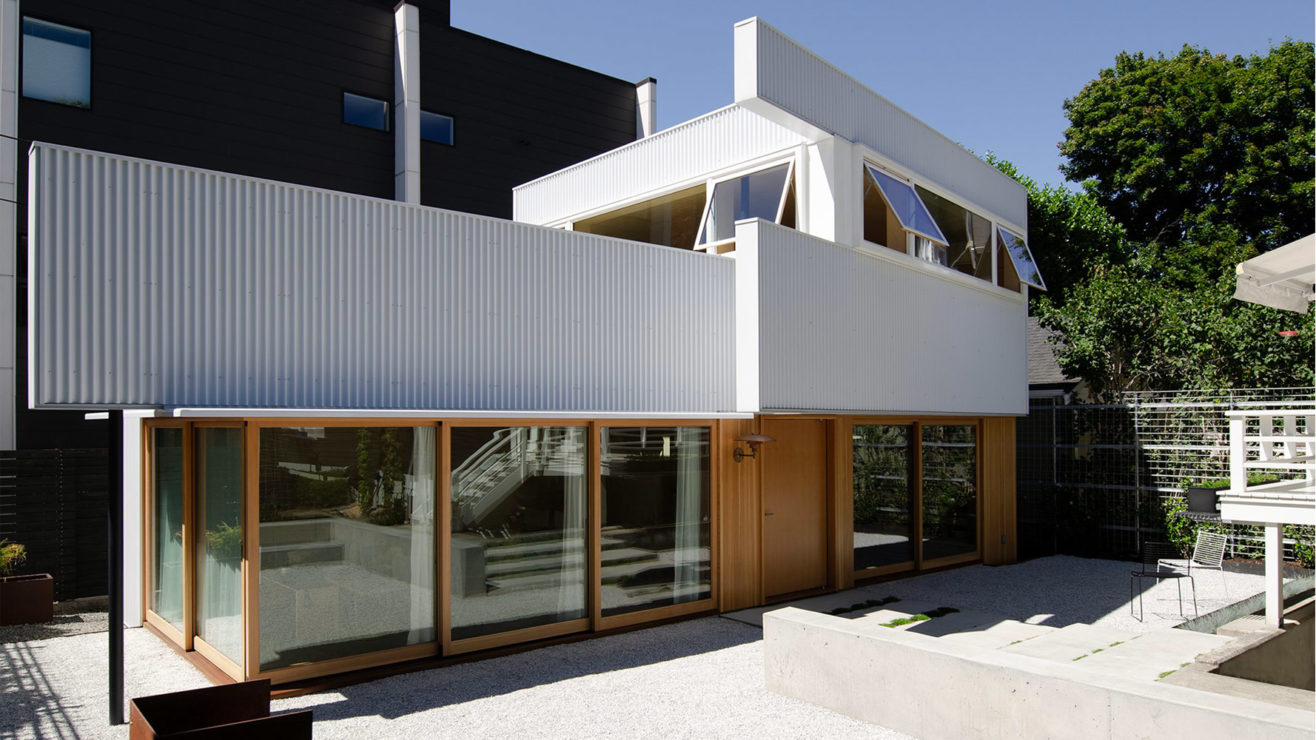
Boston Loft, Boston
Photo courtesy The Galante Architecture Studio
Boston Loft, Boston, 2005


Click here to see images of six projects by The Galante Architecture Studio.

Rate this project:
Based on what you have seen and read about this project, how would you grade it? Use the stars below to indicate your assessment, five stars being the highest rating.
----- Advertising -----

Ten years later, The Galante Architecture Studio is in full swing. With a staff of four, Galante has moved his practice from a few residential projects to a full plate of commercial endeavors—with honors along the way, including an AIA New England and Boston Society of Architects Design Excellence Award for the Falmouth Recreation Center in Massachusetts (right), in 2003.

Other current work includes two fire stations—in New York City and Boston—and a planning project for a wiring and cable company that requires industrial warehousing and is looking to develop a 22-acre parcel of land on the outskirts of Boston.

How does this small firm get projects? “I have no idea,” says Galante. “Or at least, no consistent method. One client I got because we got to talking in the architecture section of a bookstore. Others we get from word of mouth or with portfolio submissions.” Galante’s firm hasn’t got commissions from competitions, exhibitions, and design exercises, he says, but he continues to make them a mainstay of his firm. For the exercises, the team will pick a local property and design a structure for it. The Grudge House (far left) is one example. “It’s pure fun,” says Galante, “to keep our hearts beating. Design excellence requires it. Those, and the exhibitions, don’t directly bring in work, but we get an awful lot of résumés as a result.” With a mix of projects and a firm with a strong heartbeat, it seems the work, and the résumés, will keep coming. 

share: more »

 Reader Comments:

Sign in to Comment

To write a comment about this story, please sign in. If this is your first time commenting on this site, you will be required to fill out a brief registration form. Your public username will be the beginning of the email address that you enter into the form (everything before the @ symbol). Other than that, none of the information that you enter will be publically displayed.

We welcome comments from all points of view. Off-topic or abusive comments, however, will be removed at the editors’ discretion.

----- Advertising -----
Read dispatches from an Architecture for Humanity Fellow working in South Africa
View all blog posts
Recently Posted Reader Photos
View all photo galleries
Recently Updated Reader Profiles