|
By Ingrid Spencer
Jinhee Park and John Hong, AIA, principals of Single Speed Design (SsD), grabbed the firm name from the single-speed bicycles they ride around on in Cambridge, Massachusetts. Although they didn’t mean the name to stick, in the end they decided to keep it. “We had a project, so we had to come up with something in a hurry,” says Hong. “We thought we’d change it later, but it somehow fit us.” Functional, simple, and aesthetically pleasing, the bikes represent the kind of architecture Park and Hong aspire to make. “We want to bring out the essence of design,” says Hong, who says he even stripped all decals and branding from his bike.
 |
|
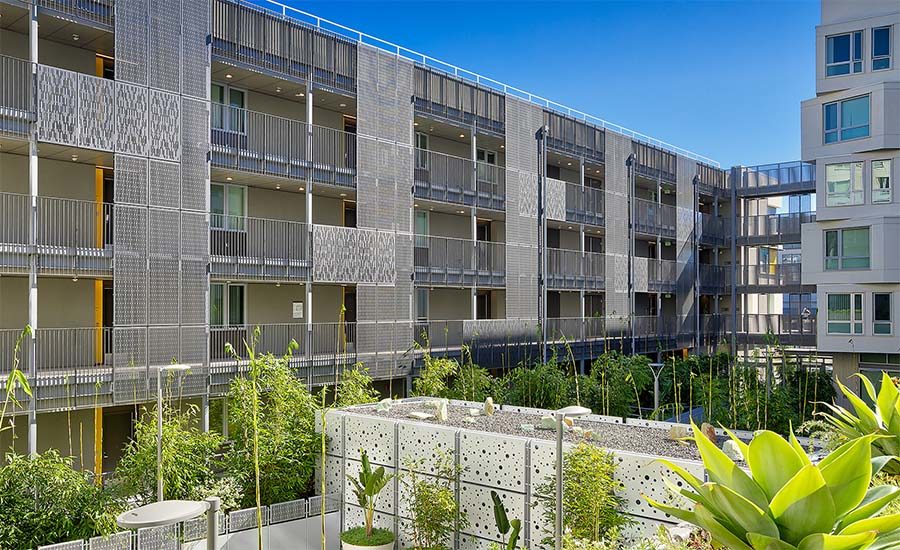
Yet while simplicity is one of the concepts Hong and Park tout, complex and demanding theories have made their way into the fledgling practice’s work, with maximum results. In just three years, the now-five-person firm has created locally and nationally award-winning multifamily housing in Boston, as well as a home built almost entirely of leftover materials from the city’s Big Dig project. It has also achieved honorable mentions for designs submitted to global competitions.
The Big Dig House in particular is an example of Hong and Park’s ability to take risks. They had been given the chance, by a developer willing to try something different, to design the Valentine Houses, a multifamily housing structure in Cambridge. A contractor in charge of destroying the residual materials from the Big Dig’s construction saw the Valentine project and contacted SsD. “He had a junkyard full of concrete and steel and this idea to recycle it into a house,” says Hong. Because Park and Hong’s client was willing to let his home serve as a research project, it was a success. Using over 600,000 pounds of recycled materials, the home has become a prototype for recycling large, heavy materials, and a bit of a curiosity in the area.
While the house has led to other possible projects using discarded Big Dig materials for the firm, SsD is also focusing on other sustainable issues, mostly in an urban context. Both Park and Hong have ties to Korea—Park moved from Seoul, where she studied industrial design, eight years ago, and Hong’s extended family are there. While both have M.Arch. degrees from Harvard, they still look to Korea for an empirical education on how to design sustainably in a dense city. “Korea has very little land and energy resources,” says Park, “so there’s a consciousness about using energy in smart ways.” Hong adds, “It used to be that when Asian cultures were developing, they borrowed from the West. Now the West borrows from the East. It’s about creating modern designs with ancient building stock.”
One of SsD’s projects, HBNY in New York City, goes a step further in maximizing dense living. The architects researched occupancy levels in the city, and found that many buildings spend months empty, due to traveling residents. They created a loft space that three families could purchase together and share, with flexible areas that could change according to need. “We’re amazed at how receptive people have been to the solutions we’ve been presenting,” says Hong. With plans to design a LEED-certified, 7-story multifamily building in Jersey City, New Jersey, and a collaboration with a large Korean urban-planning firm in the works, it seems SsD is full speed ahead. |