Click
to see larger


Corner
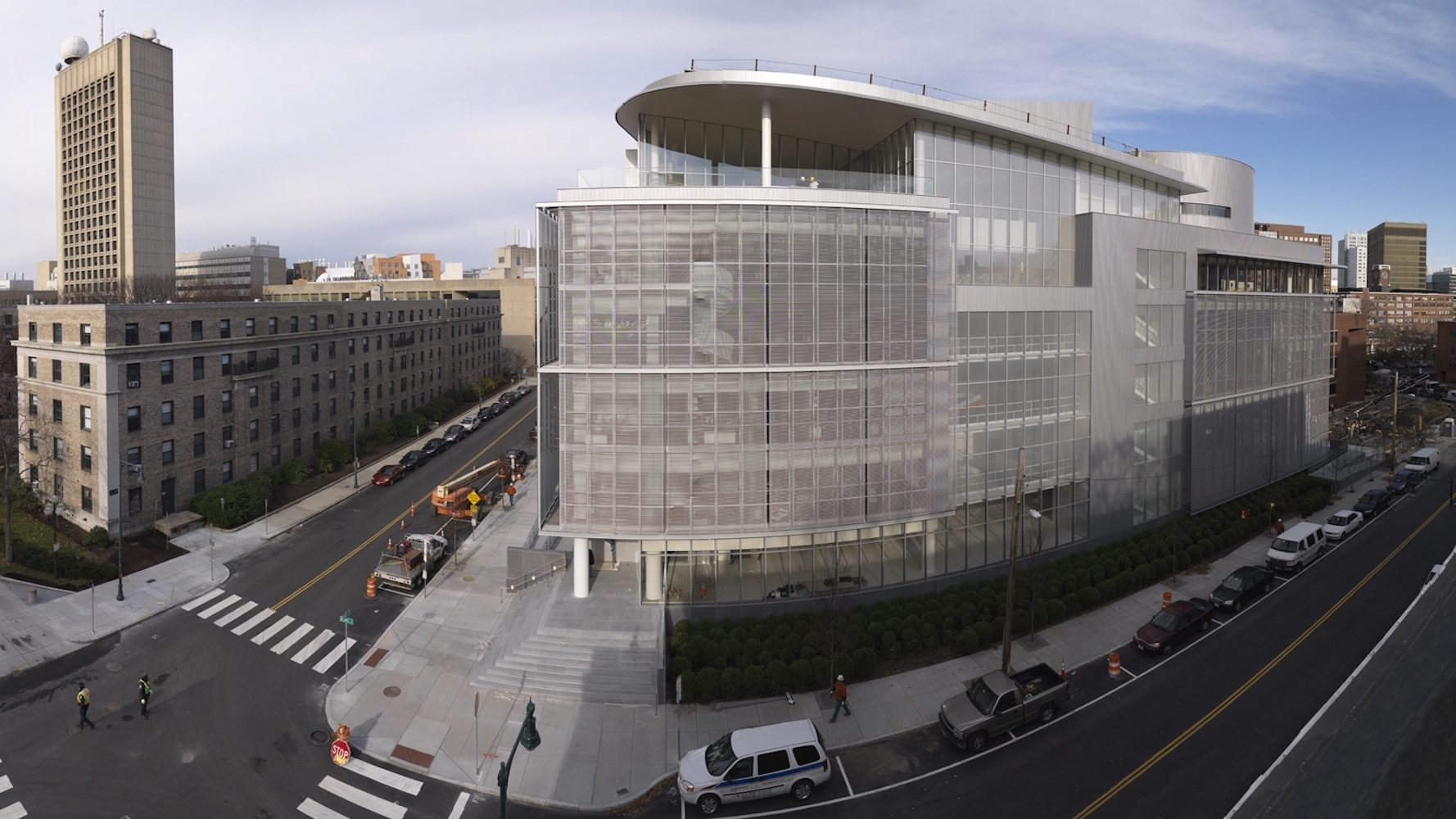
at the Loading Dock - Main Façade
|
|

Time magazine recently
selected Steven Holl as the best architect in the United States. This
is an important prize, adding popular prestige to an already successful
career as an architect. On the flip side, however, it throws a huge responsibility
on Holls shoulders. Now, he is the best. His buildings immediately
become objects of public scrutiny. From young architects to experienced
scholars, people look at their buildings as intellectual references, and
for a standard of our finest architecture. From general design to detail,
every corner in Holls buildings is going to be studied and researched.
Prizes have many
effects besides celerity. They point toward specific trends within the
industry. Architectural prizes, like the Oscars, tend to award originality,
innovation and risk. Purposefully, they dont usually award simplicity,
economy and common sense. They like innovative detailing but dont
really care about consistency. They praise flashy rhetoric as opposed
to simple construction. If Holls Bellevue Art Museum is not an example
of super hip architecturelike Gehrysit is also not an
example of modest design.
Ive been to
the Bellevue Art Museum many times. Living in Seattle gives me the opportunity
to explore Holls building repeatedly. I really like the building.
During my last visit, however, I had a different sort of idea in the back
of my mind. I went there to find mistakes and errors and to purposefully
ignore the buildings qualities. As a result, I spent a few hourslike
an architectural Sherlock Holmessearching for concepts and details
that didnt work. And, although I did find a few flaws, overall,
I intuitively like the building. Still, I believe that everybody can profit
from a debate about architectural ideas and imperfections.
|
|
|
Detail
"A" - Ceiling and Vent at Upper Floor Stairwell

Glazed
Stair: a problematic ceiling datail

A
complex fixture in the Forum
|
|
Poor Corners
When I was in college, I was taught to be particularly careful in the
detailing of corners. Intersections of different materialsIve
been toldpresent a special challenge, since materials can rust or
break, and insulation or fasteners can be exposed. At the intersections
we were supposed to avoid the "open corner" and, whenever possible,
try to use a "closed corner". That was the rule of thumb.
To my surprise, however,
Holl has done exactly the opposite of what my professors advised me to
do. He deliberately used the "open corner" at the intersection
between aluminum panels and concrete walls. Why did he do that? There
is no flashing. There is no "L" or "C" channel in
the end of the aluminum wall, either. Aluminum panels are not protected
or finished. Is this the way it is supposed to be?
Apparently, Holl produced
this detail because he is concerned with the purity of the design. Walls
covered with aluminum panels meet concrete walls as if they dont
have any materiality. They are two aesthetic entities. They meet like
two plain surfaces on watercolor paper. Yet, they are not two surfaces
on a piece of paper. Is this logical? Is this detail the result of pure
aesthetic pursuit?
Difficult
Stair
I wonder if
Holl paid too large a price for his seductive watercolors. In the glazed
stair, for example, floating glass panels dive into the ceiling as natural
light comes down from the sky. It is indeed a beautiful concept. Yet Hall
refuses again to admit the materiality of the glass. Conceptually, the
glass panels are supposed to float in space, so they receive minimal support.
They are not firmly connected to one another. For the sake of design,
there is no frame for the glass (just a small line along the base on the
stair). As a result, these panels dont align well and look disturbingly
fragile.
The glazed stair
is supposed to bring light to the main halland it doesbut
it carries other functions as well. It hides concrete steps and works
as a huge light fixture on the underside. Glazed panels envelop, simultaneously,
a skylight, the stair steps, railing and underside light fixtures. Apparently,
there are far too many functions to be enveloped by simple translucent
panels and their delicate detailing. This stair is supposed to be pure.
But, it is not. The shadows of the steps are a confusing part of the design.
They dont really agree with the simplicity of the glazed panels.
Are these steps supposed to be invisible or visible? Worse yet, does a
light fixture-cum-ceiling make sense? It definitely doesnt work
very well. The panels are dirty (I presume they can be cleaned), uneven
and unaligned. Are they supposed to artificially generate the same light
as the panels above?
|
|
Façades:
intersection between materials

View
from Belleview Way

Section
"BB"

North
Light Gallery: an interrupted clerestory window |
|
Broken Northern Light
The Northern Light Gallery is at the top of Holls building.
It is its largest exhibition space and also one of the most dramatic ones.
Its ceiling slopes down and a long and narrow window (or skylight?) follows
the slope. The drama of space reminds me of the sets from the expressionist
movie, The Cabinet of Dr. Caligari. It is a very powerful image. Unfortunately
however, the narrow window that follows the ceiling doesnt have
a corresponding element in the exterior elevation. Looking from the gallery,
we are left with a shadow that splits this expressive window in two parts.
Does it make sense?
In modern architecture,
windows are consistent from the inside to the outside. In other words,
an opening in the outside corresponds to an opening in the inside, presumably
in the same shape and size. If many contemporary buildings adopt false
windows, they do it as a compromise, trying to compose beaux-arts symmetries
or proportions in their facades. But Holls building is definitely
not beaux-arts, is it? So, why does he adopt this beaux-arts trick?
I can understand Holl
when he argues (controversially, one might suggest) that he doesnt
mind the cracks in the main gallery floor. He wants it brutally simple.
I can buy that. Still, there must be a good explanation for that wall
behind the window in the Northern Light Gallery. Is it just aesthetic
sake of continuity? Here, something has to be wrong. If an outside facade
doesnt agree with its interior elevation, this is not modern architecture.
This is set design. And, I wonder: is this justifiable? Is this a beaux-arts
approach in an otherwise modernist building?
Imperfect
Ceiling
I believe that all the flaws in this building come from one
single source. Holl wants his building simple, simple, simple. He wants
it pure. He wants it clean. Ceilings, for example, are designed as flat
gypsum board or stucco surfaces. They are as simple as they appear in
Holls watercolors. But ceilings today have many functions. They
have accessible doors. They have air vents. They meet soffits and corners.
Should a design treat the ceiling as a simple continuous surface?
I would like to hear
Holls opinions on my observations. They would create an interesting
debate. Do my comments make sense or not? In a way, I believe that all
my questions point to an old problem in modern architecture. Do aesthetics
prevail over construction? How far can an architect go to force construction
to adapt to his design?
Steve, what do you
think?
Return
to index
|
|