| |
Continued
from page 2
III
And
so we get to my title: What is an Event and What is its Duration
On September 25 at
a convocation of New York architects in the Great Hall at Cooper Union,
my colleague, Michael Sorkin concluded his remarks about the tragedy of
September 11 by stating the following:
"We've
been hearing for years about architecture as event space. Here is
an event. What now?"
As an architect and
educator, I felt the sharpness of Sorkins point. It cuts in two
ways. Firstly, of course, it refers to the architectural academys
interest in the contribution of European critical theory and philosophy,
post-1968 - or what Jacques Derrida referred to as "that event
one still does not know how to name other than by its date."
This interest on the part of the academy was/is most typically motivated
by Foucaults "events
in thought" - those disjunctive "singularities" that
can neither be explained nor predicted by the normative logic of their
social context and which forever thereafter must necessarily change that
very same context. Sometimes per Deleuzes early interest in Foucault
- and I think here is what Sorkin held in mind - it is the event
of the spectacular, the spectacle, which compels our way of thinking
about architecture both in relation to space and program who here
in the past decade has not attended a review without having crossed paths
with this reference?
However, when Sorkin
says, "
Here is an event. What now?
", he seems
to be referring to something quite different. He is adopting the plain-speak
of so many who dont have a clue about post-modernist or post-structuralist
thought but who think of an event in terms of Websters marvelously
dead-pan and understated definition: "a happening or occurrence,
esp.
when important."
There is irony here,
of course. Sorkin has conflated both notions of the "event"
and, in so doing has elevated Webster to a proper level of urgency and
immediacy while hauling the architecture academy down to pay attention.
His point here, and
I will take it as mine as well, is not an anti-intellectual one. For to
dismiss the critical and important work that has been done in the architecture
schools and elsewhere over the years would be to ignore an extraordinary
intellectual development that has informed not only theoretical practice
but material practice as well. Most important in this development, in
my judgment, has been a more relaxed understanding of truth and objectivity.
This loosening up of ontological perspective has helped us to focus on
what the post-modern historian Patrick Joyce has called the "capacious
and greatly stimulating assemblage of ideas about such things as the nature
of identity, the significance of representation, the production of knowledge,
and the nature of social life." Indeed, it is this latter interest
in the nature of social life that has had a remarkable influence on the
direction of architecture programs everywhere. Read any academic catalogue
or website and you will find some reference to architecture as social
practice.
Now, architectures
stated involvement with social agendas is certainly nothing new at least
since the advent of humanist secular thought. It has taken many forms
from Ledoux & Boulee to Gropius & Meyer to Debord & the Situationists,
etc., etc. However, there are perhaps a couple of things which differentiate
our current preoccupation with sociality from that of our predecessors.
Firstly, there is
the absence of the utopian motive coupled with - indeed to some degree
produced by - a sharpened awareness of the contingency of historical events.
Absolutism and Universalism with their teleological promise of an ideal
state of affairs no longer appear to hold much currency except perhaps
in ones religious life. But that, as it should be, is a private
affair and if there is anyone here who disagrees with this point, my comments
will be a waste of your time and I would only remind you as you leave
of Mr. Bin Ladens worldview.
But there is another
difference in our present thinking about social space and it, as well,
relates to revised thinking about history. In this case, I speak less
of historical events than the actors involved and the cultural configurations
in which they perform. The rise of cultural history propelled by anthropology,
social geography, and critical theory has helped us to understand and
appreciate the complexities of social life and welfare while steering
us away from reductive social solutions driven, for example, by libertarian
appeals to natural or individual rights or neo-Marxist calls for capital
and communal reformation, just to name a popular few. Today to speak of
the social is to speak of the cultural. And to speak of cultures today
is to speak of globalism.
Now
, before
I continue, I want to state, unequivocally, that this is not simply another
rant about multi-culturalism. Indeed, I dont even know if I understand
what this term means given its over-extended use in coercing politically-correct
social behavior. Furthermore, I am not a relativist and I dont think
all cultures are equal in a world that is struggling with the idea that
freedom might be a useful value to hold. However, it seems clear to me
that for architecture to make social space, one needs to understand that
there are culturally produced communities which have past histories, present
social practices, and intentions for a future.
This is what "Global
after 9.11" means to me. More importantly, it is what globalism
in its most fundamental and, I think, provocative sense has always charged
us with. Too much attention in academic architectural thought about globalism
has been directed toward either the techniques that facilitate the globalist
phenomenon or toward the brave new worlds these techniques might portend.
Furthermore, these two tendencies, as one might expect, are typically
expressed in the same celebratory vocabulary describing digitized informatics,
condensed or hyper time-space, virtual sociality, Being as network, etc.,
etc. This limited focus on globalism has produced some graduate students
who are interesting designers and fictionalists but who also have very
little sense of history or deep time.
To think of globalism
without being provoked by the fascinating and critically important understanding
of diverse human histories and cultural formations is to overlook ourselves.
But again, I want to appeal to your intellectual aspirations rather than
harangue you for your personal politics. This is not a call to ethics
nor am I invoking moral imperatives
again, these kinds of things
are based on other kinds of decisions we all must invariably make in private.
No, my concern is more simple. The more things we know, the more things
we can draw upon to provoke our imaginations. And one of the things that
we, that is, our species, has consistently tried to imagine, even now
in the absence of utopian schemes, are ways to make human experience more
rich in its expression, more interesting in its endeavors, and more just
in its social practices.
II
At this point, I should
applaud your patience in staring at these two images for so long without
my explaining them. Maybe I dont need to. Nonetheless, here goes.
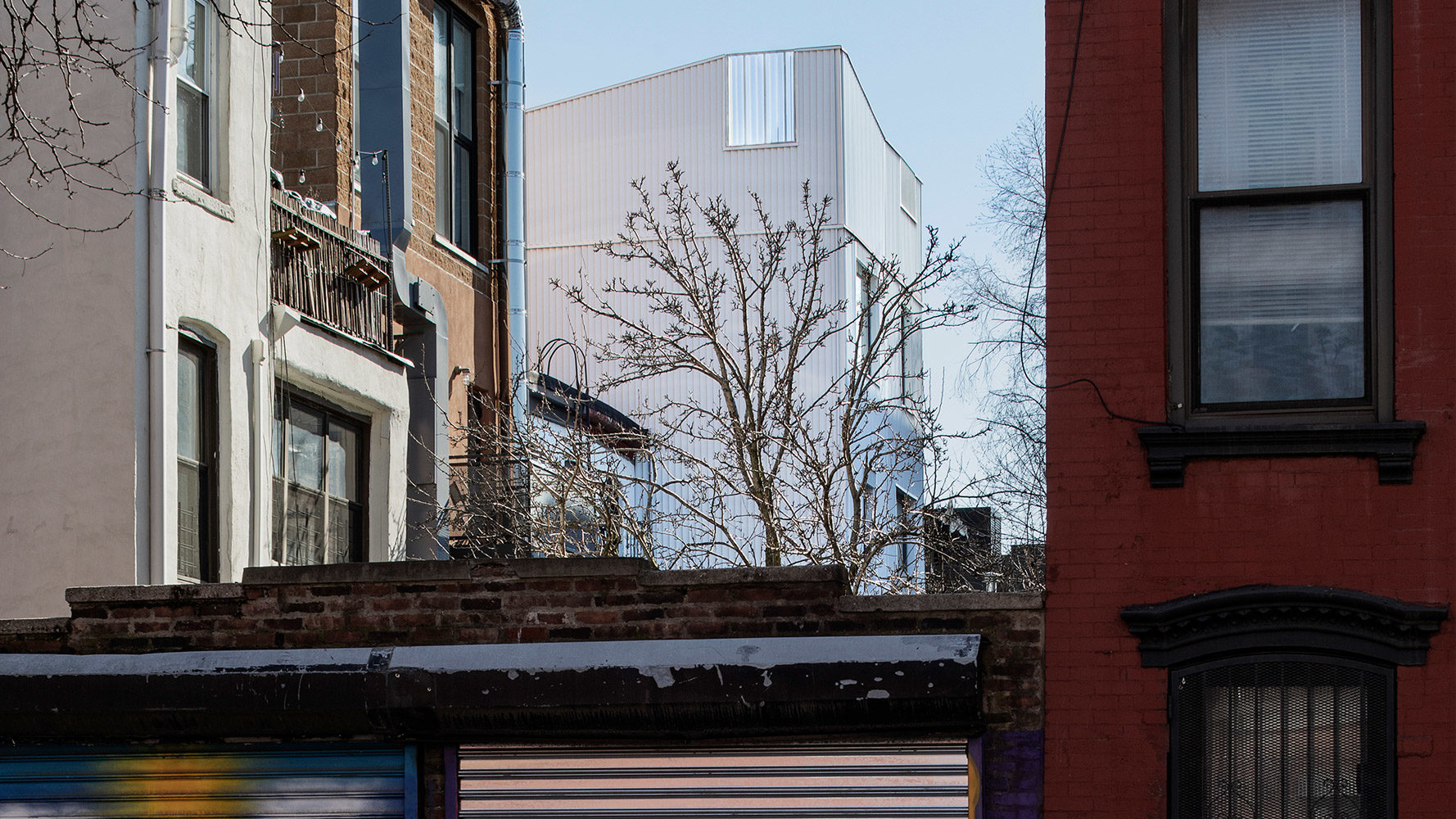
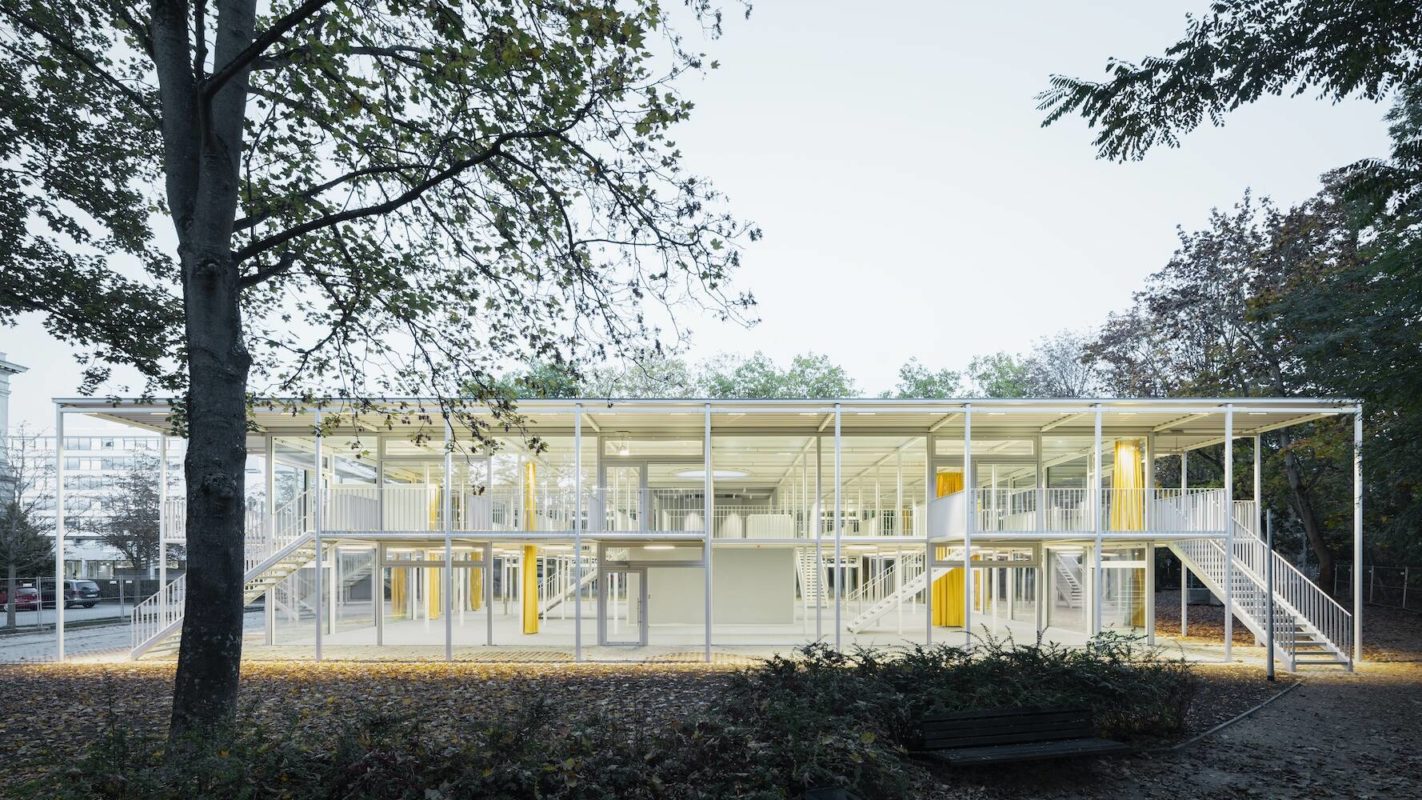
The left slide (see below) shows a detail of a project my office
completed a few years back. Its from a roof-top writing studio whose
fenestration attempted to formally iterate the distant content of its
frame and collapse or re-configure that mediatory space between the thing
viewed and the viewer. Simple idea about people and things in space. The
slide on the right (see below) is a simple idea about people and
things in time. It shows a diagram adapted from Edmund Husserl by Merleau-Ponty.
Husserl , as Im sure many of you know, was the philosopher of modern
phenomenology and who inspired a host of European philosophers who came
after. Merleau-Ponty, Heidegger, Sartre. All of whom, including Husserl,
became the targets of the next generation
Derrida, Foucault, Habermas,
Deleuze and others who have become fundamental in architectures
household of academic theory. Parenthetically, I should note, that one
of the fun things about American pragmatists is that we have no self-doubts
about utilizing the good ideas of other philosophers.
In any case, Merleau-Pontys
diagram strikes me as a useful tool to illustrate this simple idea about
people and things in time. Read the horizontal line as points in present
time, the vertical lines as points related to past time and the oblique
lines as points related to the future. I am going to describe the dynamic
of the diagram in quotes from Jean-Francois Lyotard who first drew my
attention to it.
Time is not a line
but a network of intentionalities. When I slide from A to B, I keep hold
of A through A and beyond
We must still note that when B becomes
C, B also becomes B, and that simultaneously A, already fallen into
A, falls into A. In other words, my time moves as a
whole. What is to come, which I grasp at first only through opaque shadings
(the oblique dashed lines), comes to pass in person for me; C2 descends
into C1, then gives itself in C in my field of presence, and even as I
meditate on this presence C traces itself out for me as "no longer",
for now my presence is in D.
In other words,
my time moves as a whole
The present is not closed but always transcends
itself toward a future and a past.
This is what I mean
about deep time and a sense of history. Looking deeply in both directions.
III
I have,
so far, kept the detail of September 11th somewhat at bay.
I am glossing the usual rhetoric about our countrys extraordinary
blunders in not anticipating what now seems to be the inevitability of
an event like this but I hope my remarks above convey that I share this
belief about our countrys mistakes. Nevertheless, as a committed
believer in constitutional democracy, I view our shortsighted geopolitics,
cultural hegemony, and utterly transparent double standards not as stemming
from any necessarily abusive logic of late capitalism nor insidious interest
in cultural imperialism (although such an account seems accurate in local
cases
see Enron). Rather our national ethic reflects the over-grasping
naiveté of a well-meaning but awkward nation-state too giddy with
its own remarkable successes on the global stage to understand its growing
responsibilities in global affairs.
I was one of the speakers
who joined Michael Sorkin, and others in the Great Hall at Cooper Union
last September. I spoke about my familys escape and the confusion
we felt running away. I quote from it here :
"North and
West would take us deeper into the towers shadows; North and East
lay City Hall; South was toward Battery Park, Federal landmarks, the Statue
of Liberty; due East, the NY Stock exchange and Federal Hall. It was a
confusing moment when we believed not that the towers would collapse but
that we might be experiencing a sustained attack on specific targets.
To run in any direction - it seemed to me - was to find oneself situated
within a space suddenly highly charged; a luminescence rung by the material
and memorial fabric of our history, our city, our nation, and our international
identity."
I concluded my talk
with a deferral about the future of the WTC site as follows:
"When they
were first built, the World Trade Towers were remarkable for the cleavage
they cut through architecture culture - a duel, so to speak, between those
architects who hated them and those who loved them. It was a healthy discussion
at the time and raised a number of important stylistic, urban, and political
issues that still lurk in urban discourse today. But in the past 30 years
or so, these towers acquired something far more complex than any of us
could have imagined then. I think of my three young children who were
born and raised in the reflected light of those towers. I think about
teaching each of them what to do if they ever became lost in the city
and it was always with a sense of pride and proprietary right that I would
say..."just look up, kids, and head for the towers, thats where
home is."
Unlike the official government landmarks I
avoided two weeks ago, the towers had played to a larger imagination.
This, sadly, has been made abundantly clear. There seems to be a kind
of super-condensed speed to their history now
there and gone
leaving
an unfulfilled absence around which we are all now searching for our bearings.
I hope we will find them again. That is all I am sure of so far."
My point was to note
both architectural spacing and the fluidity of meaning through time and
cultural experience
how the conflation of architectural space and
meaning directed my escape and how my sense of who I was as a historical
being in time was partially constituted by the architecture out my window.
Finally, I was referring to the extraordinary symbolic force that the
Towers held - a force that both directed the attack from those who saw
them as epitomizing an antagonistic and self-satisfied culture and, on
the other hand, that now directs the mourning of a proud and progressivist
nation that has trouble understanding why others might resist the way
of life they exemplified.
If Foucault is correct
in believing that "events in thought" structure the human
project, and I, for one, think that he is correct here, then we are using
this foundational architectural term to mean that we are constantly constructing
ourselves through time and that architecture is always implicated. Furthermore,
the sociality that is being produced in this moment stands at the advent
of globalism and its actual formation is still beyond our visible horizon.
Yet, I am also suggesting that to think of an event, in its most meaningful
sense, either as a Foucaultian singularity or a Websterian "occurrence"
is not useful. Events may seem to emerge illogically like epi-phenomenon
from within a given cultural context but they do have a history and portensions
for a future. To not understand this is to ignore deep time as our, otherwise
remarkable, democracy has often done and to find ourselves poorly poised
in confronting the social space of globalism.
|
|